
In the days following the 22nd May 2014 coup, demonstrations at Victory Monument in Bangkok were initially tolerated by the junta, though by June of that year, police were being stationed at likely venues to pre-empt any potential protests. Opponents of the coup turned to symbolic acts such as the three-finger salute from the Hunger Games film series, briefly disrupting a speech by coup leader Prayut Chan-o-cha on 19th November 2014.
The protest movement was revived in February 2020, with ‘flash mob’ demonstrations on university campuses following the Constitutional Court’s dissolution of the Future Forward party. Future Forward’s progressive policy platform had received overwhelming support from younger Thais eager for structural change, and the party’s abolition was seen as a return to the status quo.
The protest movement was revived in February 2020, with ‘flash mob’ demonstrations on university campuses following the Constitutional Court’s dissolution of the Future Forward party. Future Forward’s progressive policy platform had received overwhelming support from younger Thais eager for structural change, and the party’s abolition was seen as a return to the status quo.

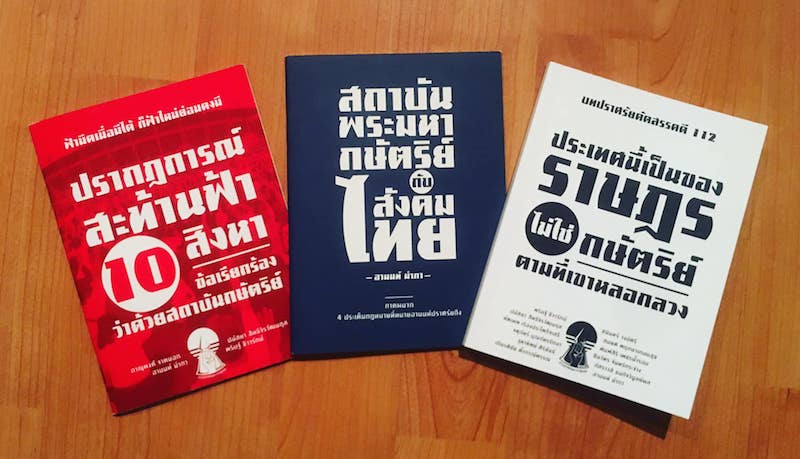
The first mass protests took place on 18th July and 16th August 2020, when more than 10,000 people attended rallies at Democracy Monument organised by Free Youth. Lawyer Arnon Nampa led a smaller protest there on 3rd August 2020 (the so-called Harry Potter rally). A week later, at a Thammasat University protest organised by United Front of Thammasat and Demonstration, student Panusaya Sithijirawattanakul read out a ten-point manifesto calling for greater oversight of the monarchy.
The movement increased in popularity and momentum, and tens of thousands of people attended an overnight rally at Thammasat on 19th September 2020. On 14th October 2020, protesters marched from Democracy Monument to Government House, and the government declared a state of emergency in Bangkok.
The movement increased in popularity and momentum, and tens of thousands of people attended an overnight rally at Thammasat on 19th September 2020. On 14th October 2020, protesters marched from Democracy Monument to Government House, and the government declared a state of emergency in Bangkok.

Protesters regrouped at Ratchaprasong on 16th October 2020, and riot police used water cannon to disperse them. Further mass rallies were held later that week, including at Victory Monument on 18th and 19th October 2020. Water cannon was used again on 8th November 2020, when protesters marched from Democracy Monument to the Grand Palace.
Tensions increased on 17th November 2020, when riot police used water cannon laced with tear gas to prevent protesters from entering parliament. The demonstrators breached the barricades, and were met by a royalist counter-protest. Gunshots were fired, and projectiles were thrown by both sides. More violence occurred a week later when a ping-pong bomb was thrown at protesters outside the Siam Commercial Bank headquarters.
Tensions increased on 17th November 2020, when riot police used water cannon laced with tear gas to prevent protesters from entering parliament. The demonstrators breached the barricades, and were met by a royalist counter-protest. Gunshots were fired, and projectiles were thrown by both sides. More violence occurred a week later when a ping-pong bomb was thrown at protesters outside the Siam Commercial Bank headquarters.

Free Youth rebranded as REDEM (Restart Democracy), and organised a march from Victory Monument to the Viphavadi Rangsit Road military barracks on 28th February 2021. Protesters threw rocks and other projectiles at the police, who deployed tear gas and water cannon against them. The police also fired rubber bullets, in a significant escalation. There were injuries on both sides, and a police officer suffered a fatal heart attack.

Rubber bullets were also used to disperse protesters at Sanam Luang on 20th March 2021, outside Bangkok’s Criminal Court on 2nd May 2021, and at Democracy Monument on 18th July 2021. In August 2021, there were almost daily clashes near Viphavadi Road between between riot police and the radical Thalufah protest group, with rubber bullets being fired on 7th, 10th, 11th, 13th, 15th, and 16th August (when a teenager was tragically hit by a live bullet).
The three-finger campaign is the latest in a series of protests that have epitomised Thai politics over the last fifty years. Some — in October 1973 and May 1992 — resulted in dozens of casualties, though ultimately led to democratic reforms. Others — in October 1976 and May 2010 — simply ended in tragedy. Perhaps the most successful, on their own terms, have been the yellow-shirt and ‘Shutdown Bangkok’ campaigns, both of which followed the same playbook and achieved the same result (a military coup).
Ultimately, the three-finger protests did not achieve their objectives, and their leaders are now either behind bars or living in exile. But the impact of the 2020–2021 protests can be measured by the changing attitudes of younger people towards traditional national values, and by the increasing popularity of the ‘orange movement’ in recent elections.
Political Milestones:
The three-finger campaign is the latest in a series of protests that have epitomised Thai politics over the last fifty years. Some — in October 1973 and May 1992 — resulted in dozens of casualties, though ultimately led to democratic reforms. Others — in October 1976 and May 2010 — simply ended in tragedy. Perhaps the most successful, on their own terms, have been the yellow-shirt and ‘Shutdown Bangkok’ campaigns, both of which followed the same playbook and achieved the same result (a military coup).
Ultimately, the three-finger protests did not achieve their objectives, and their leaders are now either behind bars or living in exile. But the impact of the 2020–2021 protests can be measured by the changing attitudes of younger people towards traditional national values, and by the increasing popularity of the ‘orange movement’ in recent elections.
Political Milestones:
- no. 1: ‘Black May’
- no. 2: 14th October 1973
- no. 3: 6th October 1976
- no. 4: Yellow-shirts v. Red-shirts