


Thai politics over the past two decades has been dominated by the polarisation between two broad groups of protesters: red-shirts and yellow-shirts. They represent opposite ends of the political spectrum, and they are both defined by their attitudes towards the divisive former prime minister Thaksin Shinawatra.

Yellow-shirts
Street protests against Thaksin began in 2005, intensifying in early 2006 after he sold a 48% stake in his Shin Corp. business to Singaporean company Temasek. (Thaksin’s government had increased the legal limit on foreign ownership of telecom firms to enable the Shin sale, and changed the tax code to avoid paying any tax on the deal, in a blatant manipulation of the law for personal gain.)

Media mogul Sondhi Limthongkul formed the People’s Alliance for Democracy and organised weekly anti-Thaksin rallies, attended by PAD supporters wearing yellow shirts to symbolise their loyalty to the monarchy (and, by extension, Thaksin’s implied disloyalty). The first major PAD protest took place at Bangkok’s Royal Plaza on 4th February 2006.

On 5th March 2006, around 50,000 PAD protesters marched from Sanam Luang to Democracy Monument, burning Thaksin in effigy. On 29th March 2006, anti-Thaksin demonstrators gathered at Siam Square, bringing the shopping district to a standstill.
Despite its name, the PAD was definitely not a pro-democracy organisation. Sondhi caused maximum disruption and instability, creating the conditions for a military coup, which took place in 2006.
Despite its name, the PAD was definitely not a pro-democracy organisation. Sondhi caused maximum disruption and instability, creating the conditions for a military coup, which took place in 2006.

The PAD revived its campaign in 2008, occupying Government House for three months and even forcing the closure of two airports in Bangkok. After the yellow-shirts had blockaded parliament for three days, riot police dispersed the demonstrators on 5th October 2008.
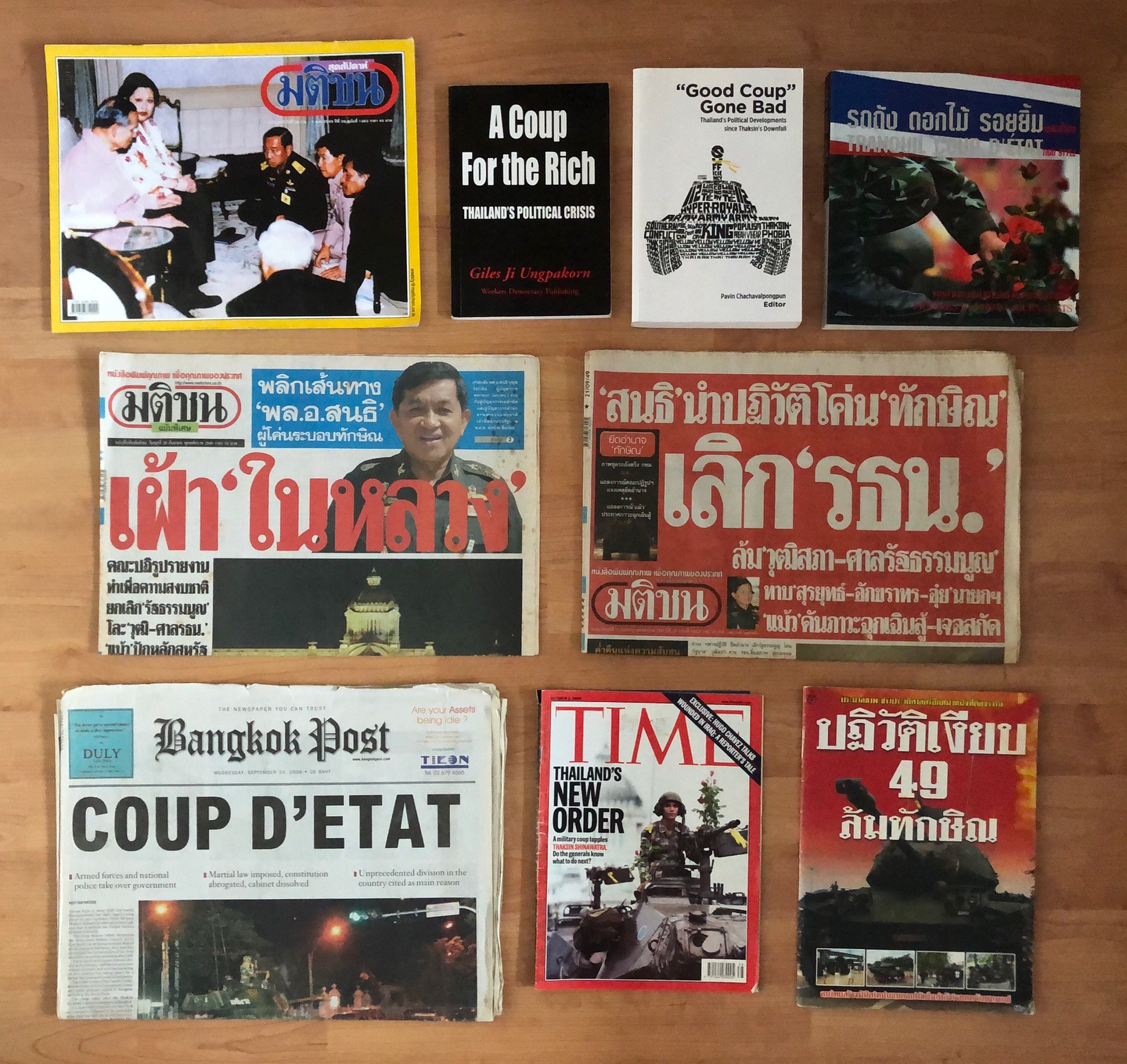
The 2006 Coup
Thaksin was deposed by a military coup on 19th September 2006. But if the coup had been designed to eradicate Thaksin’s political influence, it was unsuccessful, as even today — almost twenty years later — he remains one of the most influential political figures in Thailand. The yellow-shirt rallies had paved the way for the coup, and the subsequent red-shirt protests were held in response to it.

Red-shirts
The red-shirt movement, formally known as the United Front for Democracy Against Dictatorship, began after the 2006 coup that toppled Thaksin’s government, and for many years red-shirts were regarded as Thaksin loyalists. Unlike the more affluent yellow-shirts from Bangkok, red-shirts supporters were predominantly working-class voters from Isan and the north of Thailand.

Red-shirt protesters caused disruption in Bangkok in 2009, with a mass rally outside Government House on 8th April, followed by a violent confrontation with the military at Din Daeng on 13th April. Then, in March 2010, the UDD began a long-running and largely peaceful series of rallies near Democracy Monument, initially triggered by the seizure of Thaksin’s assets by the Supreme Court.
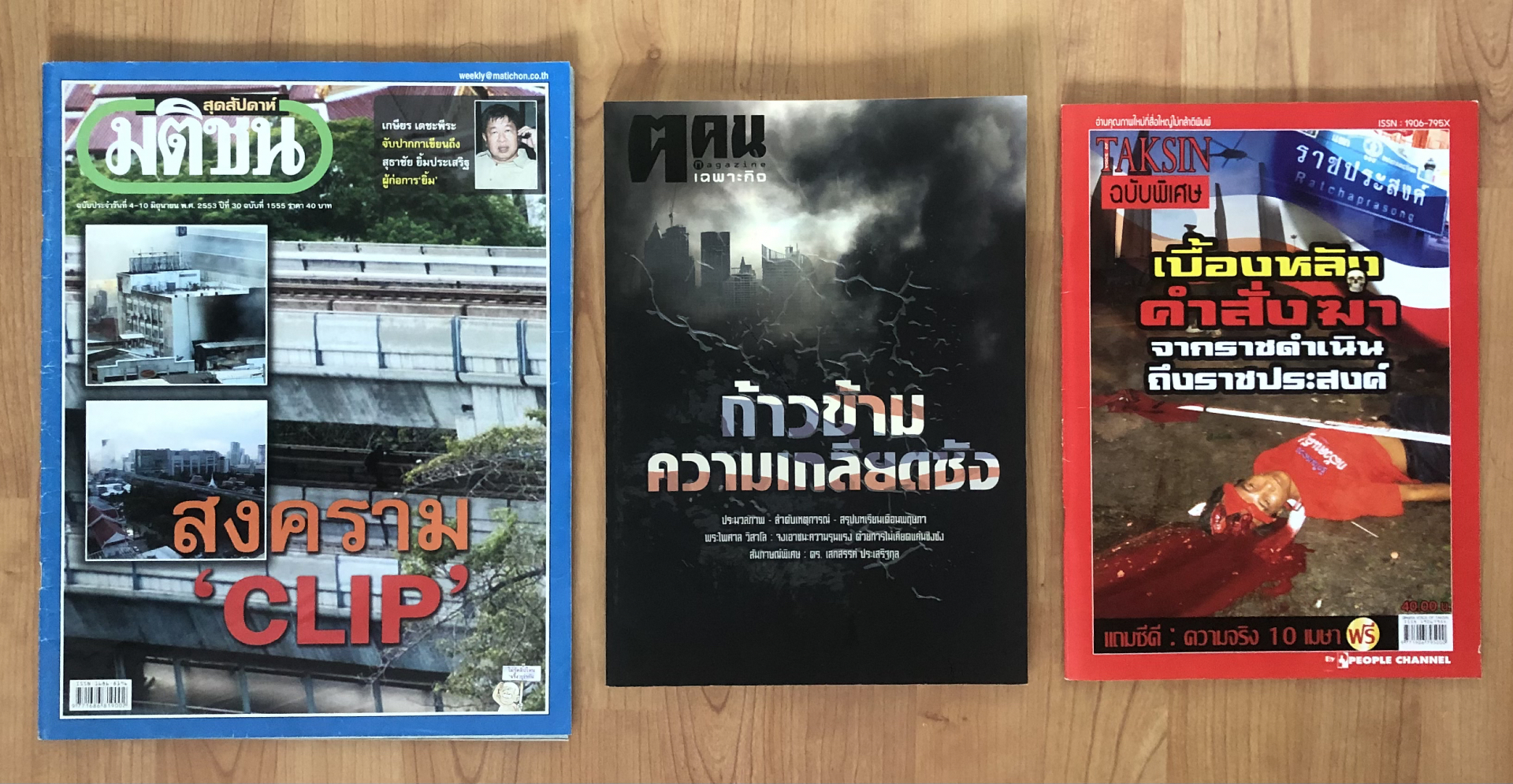

On 10th April 2010, the military launched a crackdown on the protesters at Democracy Monument. The red-shirts intensified their demonstrations, establishing city-centre protest camps at Ratchaprasong and Sala Daeng. On 14th May 2010, the camps were surrounded by armed soldiers, leading to a week of deadly street battles between protesters and military snipers.

Ninety-four people were killed in April and May 2010, a death toll exceeding the most notorious crackdowns in modern Thai history, namely October 1973, October 1976, and May 1992. The events of April and May are known in Thai as ‘เมษาโหด’ (‘cruel April’) and ‘พฤษภาอำมหิต’ (‘savage May’), respectively.

Political Milestones:
- no. 1: ‘Black May’
- no. 2: 14th October 1973
- no. 3: 6th October 1976