


This year marks the fiftieth anniversary of the violent and tragic events that took place on 6th October 1976 at Thammasat University, when forty-six people, most of whom were students, were killed by right-wing militia groups and vigilantes. The incident remains one of the most shocking moments in Thailand’s modern history.
There are more than seventy films and videos that refer to 6th October. To commemorate this year’s anniversary, MAIIAM in Chiang Mai will show a trio of these films every weekend this month.
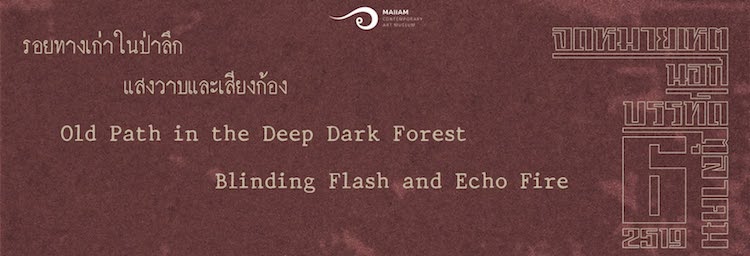
The screening programme, Old Path in the Deep Dark Forest: Blinding Flash and Echo Fire (รอยทางเก่าในป่าลึก: แสงวาบและเสียงก้อง), features a documentary, a short film, and a music video. The screenings are part of MAIIAM’s exhibition A Reconfigured Archive (จดหมายเหตุนอกบรรทัด).
There are more than seventy films and videos that refer to 6th October. To commemorate this year’s anniversary, MAIIAM in Chiang Mai will show a trio of these films every weekend this month.
The screening programme, Old Path in the Deep Dark Forest: Blinding Flash and Echo Fire (รอยทางเก่าในป่าลึก: แสงวาบและเสียงก้อง), features a documentary, a short film, and a music video. The screenings are part of MAIIAM’s exhibition A Reconfigured Archive (จดหมายเหตุนอกบรรทัด).
ชวนอ่านภาพ 6 ตุลา
(‘invitation to read images of 6th Oct.’)
In Chulayarnnon Siriphon’s documentary ชวนอ่านภาพ 6 ตุลา (‘invitation to read images of 6th Oct.’), viewers from different generations interpret a series of photographs of the incident. The images, many of which were previously unpublished, were shown at the Facing Demons (เผชิญหน้าปิศาจ) exhibition at Kinjai Contemporary in 2022.
The documentary was originally commissioned for Facing Demons. It has since been shown at the Doc Club Festival and Doc Club Festival Selections in 2024, and at Chulayarnnon’s I a Pixel, We the People (ข้าพเจ้าคือพิกเซล, พวกเราคือประชาชน) exhibition at Bangkok CityCity last year.
The documentary was originally commissioned for Facing Demons. It has since been shown at the Doc Club Festival and Doc Club Festival Selections in 2024, and at Chulayarnnon’s I a Pixel, We the People (ข้าพเจ้าคือพิกเซล, พวกเราคือประชาชน) exhibition at Bangkok CityCity last year.
Don’t Forget Me
In Manussak Dokmai’s short film Don’t Forget Me (อย่าลืมฉัน), archive footage of 6th October is accompanied by narration from a documentary on the Mlabri tribe. The narrator describes the tribe’s traditional rituals and customs, providing a blackly comic counterpoint to the violent imagery from 1976.
Don’t Forget Me has been screened numerous times since its original release in 2003, and was shown most recently at Thammasat in 2024. It was part of the Histoire(s) du thai cinéma [sic] (‘histories of Thai cinema’) programme of short films at Dam’n Cineclub in 2018, and the Chiang Mai Now! (เชียงใหม่นาว!) exhibition at Bangkok Art and Culture Centre in 2011.
Don’t Forget Me has been screened numerous times since its original release in 2003, and was shown most recently at Thammasat in 2024. It was part of the Histoire(s) du thai cinéma [sic] (‘histories of Thai cinema’) programme of short films at Dam’n Cineclub in 2018, and the Chiang Mai Now! (เชียงใหม่นาว!) exhibition at Bangkok Art and Culture Centre in 2011.
ยูงทอง 6 ตุลา
(‘golden peacock 6th Oct.’)
The music video ยูงทอง 6 ตุลา (‘golden peacock 6th Oct.’) features photographs of the 1976 massacre and right-wing newspaper reports demonising the students. These brutal images are accompanied by ยูงทอง (‘golden peacock’), a song written by King Rama IX in 1962 that became Thammasat’s official anthem.
As in Don’t Forget Me, the visuals and soundtrack are a deliberate and bitterly ironic contrast: the anthem’s lyrics espouse love, unity, and serenity, while the images on screen depict extreme intolerance, hatred, and division. The video was produced by United Front of Thammasat and Demonstration, one of the key protest groups that instigated the student-led rallies calling for institutional reform in 2020.
As in Don’t Forget Me, the visuals and soundtrack are a deliberate and bitterly ironic contrast: the anthem’s lyrics espouse love, unity, and serenity, while the images on screen depict extreme intolerance, hatred, and division. The video was produced by United Front of Thammasat and Demonstration, one of the key protest groups that instigated the student-led rallies calling for institutional reform in 2020.