

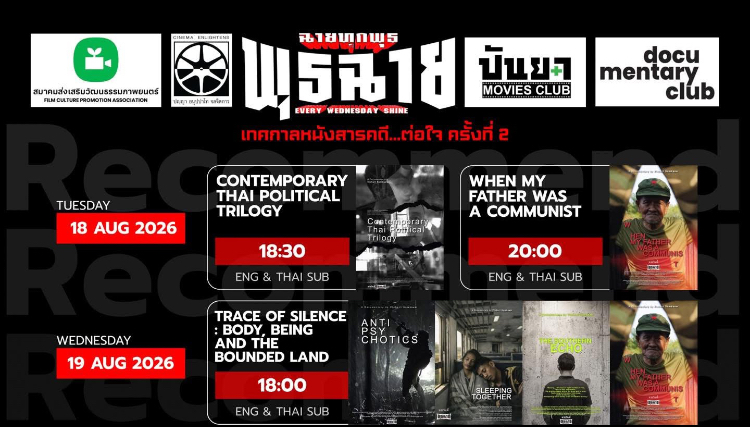
Wednesday Shine, the Chiang Mai microcinema, will show a retrospective of films by Vichart Somkaew today and tomorrow, at an event titled เทศกาลหนังสารคดี... ต่อใจ ครั้งที่ 2 (‘documentary film festival... connecting hearts, 2nd edition). The event begins today with the anthology film Contemporary Thai Political Trilogy (ไตรภาคการเมืองร่วมสมัยไทย). Tomorrow, three of his more recent shorts will be screened in a programme titled Traces of Silence (ในรอยแผล ความเงียบงัน). Vichart’s feature-length documentary When My Father Was a Communist (เมื่อพ่อผมเป็นคอมมิวนิสต์) will be shown both today and tomorrow.

Contemporary Thai Political Trilogy
Contemporary Thai Political Trilogy is a portmanteau project combining three short films: Cremation Ceremony (ประวัติย่อของบางสิ่งที่หายไป), 112 News from Heaven, and The Letter from Silence (จดหมายจากความเงียบ). The three-part structure reflects what the director sees as the three eras of modern Thai politics: 1932–1957 (the abolition of absolute monarchy and the establishment of democratic institutions), 1957–1992 (Cold War military dictatorship), and 1992 to the present day (liberal reforms, followed by political polarisation).
It begins with Vichart’s most directly political film, Cremation Ceremony, in which the faces of three politicians stare impassively at the viewer. The three men — Anutin Charnvirakul, the Prime Minister; Abhisit Vejjajiva, a former PM; and former army chief Prayut Chan-o-cha — are associated with three tragic injustices. Anutin oversaw the Thai government’s initially sluggish response to the coronavirus pandemic. Abhisit authorised the shooting of red-shirt protesters in 2010. Prayut led the 2014 coup, and his military government revived lèse-majesté prosecutions.
Vichart sets fire to photographs of the three men, their faces distorting as the photographic paper burns. There is no sound except the crackling of the flame. This symbolic ritual is a reminder of the deaths of Covid-19 victims, red-shirt protesters, and political dissidents, though it’s also a metaphorical act of retribution, as the three politicians have faced no consequences for their actions. (Anutin is a billionaire, Abhisit was cleared of all charges, and Prayut acted with total impunity.)
While the three portraits burn slowly, captions mourn the forgotten victims: red-shirts shot while sheltering in Wat Pathum Wanaram, political prisoners charged under article 112, and victims of the coronavirus. (Cremation Ceremony originally ended on a hopeful note with a final caption explaining that pro-democracy parties had “emerged victorious” in the 2023 election. But after the film’s release, the progressive Move Forward Party was excluded from the governing coalition, and the optimistic caption has now been removed.)
Contemporary Thai Political Trilogy continues with 112 News from Heaven, which juxtaposes news that’s broadcast on all channels every day with news that goes unreported by mainstream outlets. On the soundtrack, an announcer reads a bulletin of royal news, a daily staple of Thai television and radio. This is contrasted with captions documenting news of “victims of the Thai state”.
Lèse-majesté is article 112 of the criminal code, hence the title 112 News from Heaven. The film’s captions feature 112 headlines from a 112-day period, detailing the custodial sentences given to those convicted of lèse-majesté and the bail denied to those awaiting trial. It ends with a quote from a royal walkabout: “We love them all the same.”
Contemporary Thai Political Trilogy’s final segment is The Letter from Silence, a series of extracts from letters by lawyer and pro-democracy campaigner Arnon Nampa to his family, written while he serves a prison sentence for lèse-majesté. Arnon’s letters are often heartbreaking, as he faces the prospect of many years in jail if convicted on further charges, separated from his wife and their two young children.
Contemporary Thai Political Trilogy was first shown in 2024 in Phayao, as part of ซิเนมากลางนา (‘cinema in the middle of a rice field’). It was also screened last year in Chiang Mai, at Resonance of Revolt, and it was part of the online Short Film Marathon (หนังสั้นมาราธอน).
It begins with Vichart’s most directly political film, Cremation Ceremony, in which the faces of three politicians stare impassively at the viewer. The three men — Anutin Charnvirakul, the Prime Minister; Abhisit Vejjajiva, a former PM; and former army chief Prayut Chan-o-cha — are associated with three tragic injustices. Anutin oversaw the Thai government’s initially sluggish response to the coronavirus pandemic. Abhisit authorised the shooting of red-shirt protesters in 2010. Prayut led the 2014 coup, and his military government revived lèse-majesté prosecutions.
Vichart sets fire to photographs of the three men, their faces distorting as the photographic paper burns. There is no sound except the crackling of the flame. This symbolic ritual is a reminder of the deaths of Covid-19 victims, red-shirt protesters, and political dissidents, though it’s also a metaphorical act of retribution, as the three politicians have faced no consequences for their actions. (Anutin is a billionaire, Abhisit was cleared of all charges, and Prayut acted with total impunity.)
While the three portraits burn slowly, captions mourn the forgotten victims: red-shirts shot while sheltering in Wat Pathum Wanaram, political prisoners charged under article 112, and victims of the coronavirus. (Cremation Ceremony originally ended on a hopeful note with a final caption explaining that pro-democracy parties had “emerged victorious” in the 2023 election. But after the film’s release, the progressive Move Forward Party was excluded from the governing coalition, and the optimistic caption has now been removed.)
Contemporary Thai Political Trilogy continues with 112 News from Heaven, which juxtaposes news that’s broadcast on all channels every day with news that goes unreported by mainstream outlets. On the soundtrack, an announcer reads a bulletin of royal news, a daily staple of Thai television and radio. This is contrasted with captions documenting news of “victims of the Thai state”.
Lèse-majesté is article 112 of the criminal code, hence the title 112 News from Heaven. The film’s captions feature 112 headlines from a 112-day period, detailing the custodial sentences given to those convicted of lèse-majesté and the bail denied to those awaiting trial. It ends with a quote from a royal walkabout: “We love them all the same.”
Contemporary Thai Political Trilogy’s final segment is The Letter from Silence, a series of extracts from letters by lawyer and pro-democracy campaigner Arnon Nampa to his family, written while he serves a prison sentence for lèse-majesté. Arnon’s letters are often heartbreaking, as he faces the prospect of many years in jail if convicted on further charges, separated from his wife and their two young children.
Contemporary Thai Political Trilogy was first shown in 2024 in Phayao, as part of ซิเนมากลางนา (‘cinema in the middle of a rice field’). It was also screened last year in Chiang Mai, at Resonance of Revolt, and it was part of the online Short Film Marathon (หนังสั้นมาราธอน).

Traces of Silence
Three short films will be shown in the Traces of Silence programme: Antipsychotics, Sleeping Together (ราตรีวิไล), and The Southern Echo. The event will also feature a Q&A with Vichart. Traces of Silence was also shown earlier this month in Hat Yai.
The Southern Echo
The Southern Echo focuses on a campaign against a proposed land bridge linking Chumphon and Ranong, a megaproject involving the construction of a new motorway, rail line, and two ports. The land bridge is part of the Southern Economic Corridor, and the head of the SEC Watch group opposing the scheme describes its potential effects on the area: “The environmental impact will be massive in scale and scope.”
Vichart uses drone shots and underwater photography to highlight the natural beauty of the region, which is under threat from the development project. Similarly, The Poem of the River (บทกวีแห่งสายน้ำ) highlighted the consequences of dredging the Lai Phan canal in Phatthalung. The Southern Echo also recalls the classic film Tongpan (ทองปาน), a dramatisation of a seminar debating the construction of the Pa Mong dam on the Mekong river.
Vichart uses drone shots and underwater photography to highlight the natural beauty of the region, which is under threat from the development project. Similarly, The Poem of the River (บทกวีแห่งสายน้ำ) highlighted the consequences of dredging the Lai Phan canal in Phatthalung. The Southern Echo also recalls the classic film Tongpan (ทองปาน), a dramatisation of a seminar debating the construction of the Pa Mong dam on the Mekong river.
Sleeping Together
Sleeping Together begins in the same way as Sompot Chidgasornpongse’s Railway Sleepers (หมอนรถไฟ), as an observational study of train passengers, though it soon develops into a moving portrait of marginalised people exploited or neglected by society and the state. It was voted best documentary at the Chiang Mai Film Festival 2026 (เทศกาลหนังแห่งเมืองเชียงใหม่ 2569), and it was also shown at The 1st Lung Film Festival (ลุงฟิล์มเฟสติวัลครั้งที่ 1).

Antipsychotics
In Antipsychotics, Vichart turns the camera on himself and reveals that he suffers from depression. In a voiceover, he describes his symptoms, which include hallucinations and feelings of paranoia. On screen, we see profiles of various antidepressant and antipsychotic drugs, and their possible side effects, accompanied by stock footage.
The director also recounts the traumatic experience that he feels led to his condition: the humiliating hazing rituals and violent punishments he endured during his conscription. “I drew a red card and was drafted into the military service”, he says, before describing the physical and mental harm he was subjected to.
In Thailand, twenty-one-year-old men must take part in a draft lottery. Vichart picked a red ticket, which means two years of compulsory military service.
There have been occasional news reports of cadets being injured — and worse — during military training sessions, though there is less coverage of the potential psychological toll that Vichart describes. At the end of his powerful and ultimately optimistic film, he argues that conscription should be replaced by voluntary service.
Like Sleeping Together, Antipsychotics was previously screened at The 1st Lung Film Festival. It has also been shown at the Thailand International LGBTQ+ Film and TV Festival 2026, the Chard Festival (ฉาด เฟสติวัล), Open Screen, and in last year’s Short Film Marathon (หนังสั้นมาราธอน).
The director also recounts the traumatic experience that he feels led to his condition: the humiliating hazing rituals and violent punishments he endured during his conscription. “I drew a red card and was drafted into the military service”, he says, before describing the physical and mental harm he was subjected to.
In Thailand, twenty-one-year-old men must take part in a draft lottery. Vichart picked a red ticket, which means two years of compulsory military service.
There have been occasional news reports of cadets being injured — and worse — during military training sessions, though there is less coverage of the potential psychological toll that Vichart describes. At the end of his powerful and ultimately optimistic film, he argues that conscription should be replaced by voluntary service.
Like Sleeping Together, Antipsychotics was previously screened at The 1st Lung Film Festival. It has also been shown at the Thailand International LGBTQ+ Film and TV Festival 2026, the Chard Festival (ฉาด เฟสติวัล), Open Screen, and in last year’s Short Film Marathon (หนังสั้นมาราธอน).

When My Father Was a Communist
For When My Father Was a Communist, Vichart interviewed his father, Sawang, and other former members of the Communist Party of Thailand. The film is a valuable social history, as the veterans explain their decisions to join the CPT, and describe their experiences in the forests of Phatthalung.
When My Father Was a Communist is also a record of the state’s violent suppression of communist insurgents, hundreds (potentially thousands) of whom were burned in oil drums in 1972. These so-called ‘red barrel’ deaths were most prevalent in Phatthalung, and have never been officially investigated. (The names of the victims are listed before the film’s end credits.) There have been other documentaries about the red barrels, but When My Father Was a Communist stands out for Vichart’s close connections to the subject: this is a deeply personal project, as he was born in Phatthalung, and he is documenting the memories of his elderly father.
The film has been screened around the country. Its most recent screenings were in Trang earlier this year, at this year’s Lung Film Festival, at last year’s Short Film and Video Festival (เทศกาลภาพยนตร์สั้น ครั้งที่), and at Hope Space in Bangkok.
When My Father Was a Communist is also a record of the state’s violent suppression of communist insurgents, hundreds (potentially thousands) of whom were burned in oil drums in 1972. These so-called ‘red barrel’ deaths were most prevalent in Phatthalung, and have never been officially investigated. (The names of the victims are listed before the film’s end credits.) There have been other documentaries about the red barrels, but When My Father Was a Communist stands out for Vichart’s close connections to the subject: this is a deeply personal project, as he was born in Phatthalung, and he is documenting the memories of his elderly father.
The film has been screened around the country. Its most recent screenings were in Trang earlier this year, at this year’s Lung Film Festival, at last year’s Short Film and Video Festival (เทศกาลภาพยนตร์สั้น ครั้งที่), and at Hope Space in Bangkok.