


A three-day arts festival will take place in Phatthalung between 22nd and 24th August. The Chard Festival (ฉาด เฟสติวัล) features a programme of films by local directors, including two short films by Vichart Somkaew: The Poem of the River (บทกวีแห่งสายน้ำ) and (in its premiere screening) Antipsychotics. There will also be a screening of Vichart’s recent documentary When My Father Was a Communist (เมื่อพ่อผมเป็นคอมมิวนิสต์). One of the best Thai short films of recent years — Chatchawan Thongchan’s From Forest to City (อรัญนคร) — will also be shown, as will Nontawat Machai and Jakkraphan Sriwichai’s short film The Circle’s Circumference (เส้นรอบวง). Screenings will take place on 24th August at the Boone coffee shop.

Antipsychotics
At the start of Antipsychotics, Vichart reveals that he suffers from depression. In a voiceover, he describes his symptoms, which include hallucinations and feelings of paranoia. On screen, we see profiles of various antidepressant and antipsychotic drugs, and their possible side effects, accompanied by stock footage.
The director also recounts the traumatic experience that he feels led to his condition: the humiliating hazing rituals and violent punishments he endured during his conscription. “I drew a red card and was drafted into the military service”, he says, before describing the physical and mental harm he was subjected to.
There have been occasional news reports of cadets being injured — and worse — during military training sessions, though there is less coverage of the potential psychological toll that Vichart describes. At the end of his powerful and ultimately optimistic film, he argues that conscription should be replaced by voluntary service.
The director also recounts the traumatic experience that he feels led to his condition: the humiliating hazing rituals and violent punishments he endured during his conscription. “I drew a red card and was drafted into the military service”, he says, before describing the physical and mental harm he was subjected to.
There have been occasional news reports of cadets being injured — and worse — during military training sessions, though there is less coverage of the potential psychological toll that Vichart describes. At the end of his powerful and ultimately optimistic film, he argues that conscription should be replaced by voluntary service.

The Poem of the River
The Poem of the River opens with a caption describing “a Royal Development Project, costing 100 million baht” to dredge the water from the Lai Phan canal in Phatthalung. The film juxtaposes tranquil images of the canal and its verdant, fertile banks — including some beautiful drone photography — with footage of the dredging process.
The effect is similar to Koraphat Cheeradit’s short drama Yesterday Is Another Day, in which scenes set in a woodland are interrupted by shots of a JCB digging up the area. The Poem of the River has also been shown at the Chiang Mai Film Festival 2025 (เทศกาลหนังแห่งเมืองเชียงใหม่ 2568), and at the Isan Creative Festival 2025 (เทศกาลอีสานสร้างสรรค์).
The Poem of the River’s next screening will be on 25th September, in the Tales from One Earth (เรื่องเล่าจากโลกใบเดียว) programme at the Mekong-ASEAN Environmental Week 2025. The MAEW screening will take place at the Mae Num Phorn restaurant in Nakhon Phanom.
The effect is similar to Koraphat Cheeradit’s short drama Yesterday Is Another Day, in which scenes set in a woodland are interrupted by shots of a JCB digging up the area. The Poem of the River has also been shown at the Chiang Mai Film Festival 2025 (เทศกาลหนังแห่งเมืองเชียงใหม่ 2568), and at the Isan Creative Festival 2025 (เทศกาลอีสานสร้างสรรค์).
The Poem of the River’s next screening will be on 25th September, in the Tales from One Earth (เรื่องเล่าจากโลกใบเดียว) programme at the Mekong-ASEAN Environmental Week 2025. The MAEW screening will take place at the Mae Num Phorn restaurant in Nakhon Phanom.

When My Father Was a Communist
For When My Father Was a Communist, Vichart interviewed his father, Sawang, and other former members of the Communist Party of Thailand. The film is a valuable social history, as the veterans explain their decisions to join the CPT, and describe their experiences in the forests of Phatthalung.
When My Father Was a Communist is also a record of the state’s violent suppression of communist insurgents, hundreds (potentially thousands) of whom were burned in oil drums in 1972. These so-called ‘red barrel’ deaths were most prevalent in Phatthalung, and have never been officially investigated. (The names of the victims are listed before the film’s end credits.) There have been other documentaries about the red barrels, but When My Father Was a Communist stands out for Vichart’s close connections to the subject: this is a deeply personal project, as he was born in Phatthalung, and he is documenting the memories of his elderly father.
When My Father Was a Communist was screened last month in Korat, Songkla, and Hat Yai. It was shown in Phimai, Phattalung, and Bangkok earlier this month. It had four screenings on 10th August: in Chiang Rai, Chiang Mai, Sakon Nakhon, and Nakhon Phanom.
When My Father Was a Communist is also a record of the state’s violent suppression of communist insurgents, hundreds (potentially thousands) of whom were burned in oil drums in 1972. These so-called ‘red barrel’ deaths were most prevalent in Phatthalung, and have never been officially investigated. (The names of the victims are listed before the film’s end credits.) There have been other documentaries about the red barrels, but When My Father Was a Communist stands out for Vichart’s close connections to the subject: this is a deeply personal project, as he was born in Phatthalung, and he is documenting the memories of his elderly father.
When My Father Was a Communist was screened last month in Korat, Songkla, and Hat Yai. It was shown in Phimai, Phattalung, and Bangkok earlier this month. It had four screenings on 10th August: in Chiang Rai, Chiang Mai, Sakon Nakhon, and Nakhon Phanom.
From Forest to City
From Forest to City is a black-and-white drama in three parts, narrated by a woman who survived the Thammasat massacre and joined the Communist insurgency. In the first part, smoke billowing from an oil drum signifies the hundreds of suspected Communists who were burnt alive in oil barrels in the 1970s.
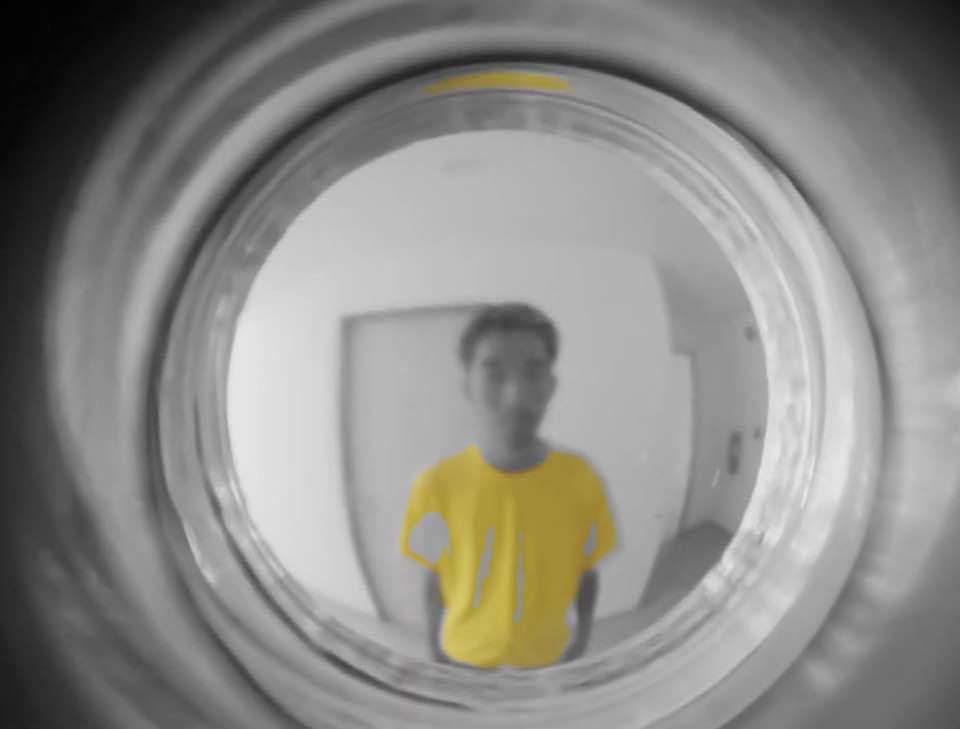
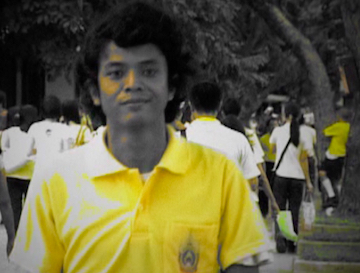
In part two, comparing the 6th October 1976 massacre at Thammasat University to the present day, the narrator regrets that Thailand hasn’t changed: society remains irreconcilably divided, between student protesters and the conservative establishment. Although the film is black-and-white, there are two flashes of colour: a red folding chair, and a yellow t-shirt. Thanks to Neal Ulevich’s famous photograph of a man beating a corpse with a folding chair, this single item of furniture has come to symbolise the entire Thammasat massacre. The yellow t-shirt in an otherwise black-and-white shot recalls Chai Chaiyachit and Chisanucha Kongwailap’s short film Re-presentation (ผีมะขาม ไพร่ฟ้า ประชาธิปไตย ในคืนที่ลมพัดหวน), in which the yellow t-shirts worn by monarchists are the only objects shown in colour.
In part three, From Forest to City switches gear with a documentary montage of various dramatic episodes from modern Thai history: the Thammasat massacre, armoured personnel carriers demolishing red-shirt protest camps, riot police firing water cannon at students in Siam Square, and Arnon Nampa’s Harry Potter-themed protest. In an echo of Prap Boonpan’s sadly prophetic short film The Bangkok Bourgeois Party (ความลักลั่นของงานรื่นเริง), a yellow-shirt mob is seen attacking a pro-reform protester. The montage of news footage is set incongruously to รักกันไว้เถิด (‘let’s love each other’), a Cold War propaganda song whose lyrics call for national unity.
From Forest to City was also shown in Phatthalung last year. It was screened at Bangkok University in 2023, and in that year’s online Short Film Marathon (หนังสั้นมาราธอน).
In part two, comparing the 6th October 1976 massacre at Thammasat University to the present day, the narrator regrets that Thailand hasn’t changed: society remains irreconcilably divided, between student protesters and the conservative establishment. Although the film is black-and-white, there are two flashes of colour: a red folding chair, and a yellow t-shirt. Thanks to Neal Ulevich’s famous photograph of a man beating a corpse with a folding chair, this single item of furniture has come to symbolise the entire Thammasat massacre. The yellow t-shirt in an otherwise black-and-white shot recalls Chai Chaiyachit and Chisanucha Kongwailap’s short film Re-presentation (ผีมะขาม ไพร่ฟ้า ประชาธิปไตย ในคืนที่ลมพัดหวน), in which the yellow t-shirts worn by monarchists are the only objects shown in colour.
In part three, From Forest to City switches gear with a documentary montage of various dramatic episodes from modern Thai history: the Thammasat massacre, armoured personnel carriers demolishing red-shirt protest camps, riot police firing water cannon at students in Siam Square, and Arnon Nampa’s Harry Potter-themed protest. In an echo of Prap Boonpan’s sadly prophetic short film The Bangkok Bourgeois Party (ความลักลั่นของงานรื่นเริง), a yellow-shirt mob is seen attacking a pro-reform protester. The montage of news footage is set incongruously to รักกันไว้เถิด (‘let’s love each other’), a Cold War propaganda song whose lyrics call for national unity.
From Forest to City was also shown in Phatthalung last year. It was screened at Bangkok University in 2023, and in that year’s online Short Film Marathon (หนังสั้นมาราธอน).

The Circle’s Circumference
Nontawat Machai and Jakkraphan Sriwichai’s The Circle’s Circumference, a video of a performance by Nontawat, was made in memory of two murdered human-rights activists, Porlajee Rakchongcharoen and Chaiyaphum Pasae. Porlajee’s body was found in an oil drum at the bottom of a reservoir in 2019, five years after he went missing, and Chaiyaphum was shot at a military checkpoint in 2017. Thunska Pansittivorakul’s film Santikhiri Sonata (สันติคีรี โซนาตา) also refers to Chaiyaphum’s death. The Circle’s Circumference was previously shown at The 26th Thai Short Film and Video Festival (เทศกาลภาพยนตร์สั้น ครั้งที่ 26).