

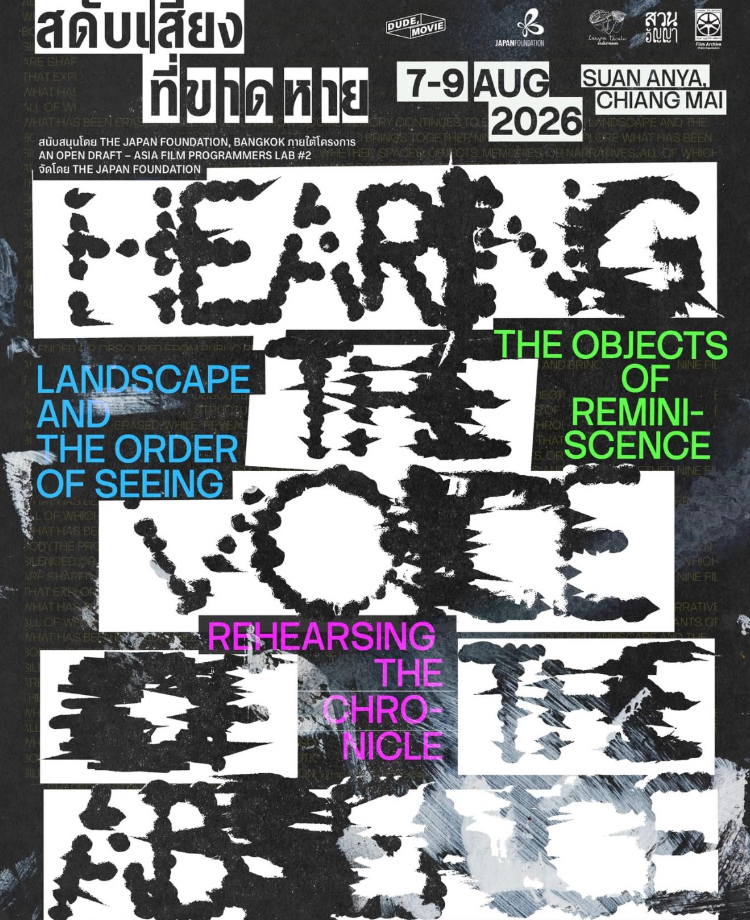
Hearing the Voice of the Absence (สดับเสียงที่ขาดหาย), a three-day programme of open-air film screenings, will take place in Chiang Mai next month. Highlights include the classic Tongpan (ทองปาน) and two recent short films, Apichatpong Weerasethakul’s Night Colonies and Anocha Suwichakornpong’s Narrative.
Tongpan and Night Colonies will be shown in the first session, titled Landscape and the Order of Seeing, on 7th August. Narrative will be shown during the third session, Rehearsing the Chronicle, on 9th August.
Hearing the Voice of the Absence is the second in a series of events, An Open Draft — Asian Film Programmers Lab, set up by the Japan Foundation. The screenings will be held at Suan Anya in Chiang Mai from 7th to 9th August, and are organised by Dude, Movie.
Tongpan and Night Colonies will be shown in the first session, titled Landscape and the Order of Seeing, on 7th August. Narrative will be shown during the third session, Rehearsing the Chronicle, on 9th August.
Hearing the Voice of the Absence is the second in a series of events, An Open Draft — Asian Film Programmers Lab, set up by the Japan Foundation. The screenings will be held at Suan Anya in Chiang Mai from 7th to 9th August, and are organised by Dude, Movie.
Night Colonies
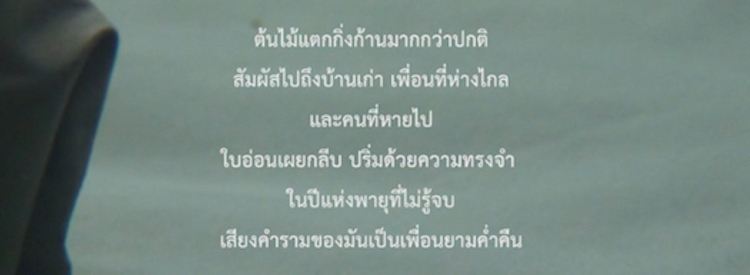
Night Colonies, originally shown as part of the anthology film The Year of the Everlasting Storm, combines two of Apichatpong’s consistent themes — light and the natural world — as it features insects buzzing around neon lights. The film begins with a poem paying tribute to “distant friends, and those who had disappeared”, a reference to pro-democracy campaigners self-exiled or abducted following lèse-majesté charges.
The poem continues: “The young leaves unfold, flushed with memories in the year of the everlasting storm.” In addition to giving the portmanteau film its title, these lines are also a metaphor for the student protesters campaigning for political reform. In fact, the film’s soundtrack includes audio recorded at protests in Bangkok on 27th July and 20th August 2020.
The poem continues: “The young leaves unfold, flushed with memories in the year of the everlasting storm.” In addition to giving the portmanteau film its title, these lines are also a metaphor for the student protesters campaigning for political reform. In fact, the film’s soundtrack includes audio recorded at protests in Bangkok on 27th July and 20th August 2020.
Narrative
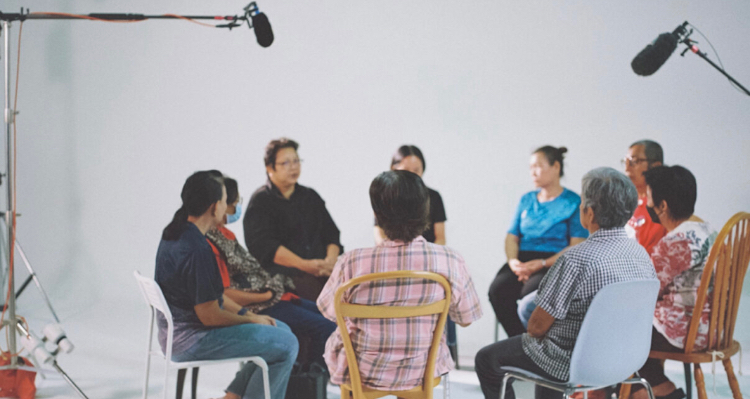
Narrative is a prelude to Anocha’s forthcoming film Fiction, in which she will stage a fictional trial of those accused of sanctioning the military crackdown on red-shirt protesters in 2010. Witnesses and relatives of the victims take part in a workshop about their memories of the event, in three guided discussion sessions.
As in Anocha’s By the Time It Gets Dark, the process of making a film about a traumatic episode of state violence self-reflexively becomes part of the film itself. Anocha and her crew are shown filming the workshop, and this acts as a distancing device, to the extent that the speakers’ words are sometimes drowned out.
As in Anocha’s By the Time It Gets Dark, the process of making a film about a traumatic episode of state violence self-reflexively becomes part of the film itself. Anocha and her crew are shown filming the workshop, and this acts as a distancing device, to the extent that the speakers’ words are sometimes drowned out.
Tongpan
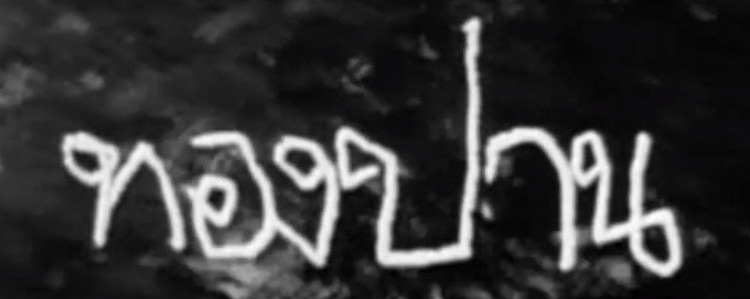
Tongpan is a realistic dramatisation of a seminar that took place in 1975, which was organised to debate the construction of the Pa Mong dam on the Mekong river. The eponymous central character is a farmer who lost his land due to a previous dam.
In the film, Sulak Sivaraksa makes an impassioned speech against the proposed dam: “Development only serves a few people in Bangkok... And what about the destruction of our country? The whole province of Loei will be flooded by this Pa Mong Dam.” Ultimately, the Pa Mong project was abandoned, though this was a Pyrrhic victory for environmental campaigners, as dozens of hydroelectric dams are currently under construction.
Tongpan was made during the brief period of political freedom after the collapse of a military dictatorship in 1973, though by the time filming had been completed in 1977, the military had seized power again, and the film was banned. Its prologue captures the optimism of 1973 (“A military junta fled into exile, and the students from the city went into the countryside to tell the farmers”), though this is contrasted by an epilogue that describes the return of military rule (“shortly after the shooting of this film, a violent coup d’etat of a magnitude never before seen in Thailand brought an end to Thailand’s three-year experiment with democracy”).
Tongpan has previously been shown at Noir Row Art Space, Cinema Oasis, Bangkok Art and Culture Centre, and the Thai Film Archive (most recently in 2024). It was also screened last year in Khon Kaen.
In the film, Sulak Sivaraksa makes an impassioned speech against the proposed dam: “Development only serves a few people in Bangkok... And what about the destruction of our country? The whole province of Loei will be flooded by this Pa Mong Dam.” Ultimately, the Pa Mong project was abandoned, though this was a Pyrrhic victory for environmental campaigners, as dozens of hydroelectric dams are currently under construction.
Tongpan was made during the brief period of political freedom after the collapse of a military dictatorship in 1973, though by the time filming had been completed in 1977, the military had seized power again, and the film was banned. Its prologue captures the optimism of 1973 (“A military junta fled into exile, and the students from the city went into the countryside to tell the farmers”), though this is contrasted by an epilogue that describes the return of military rule (“shortly after the shooting of this film, a violent coup d’etat of a magnitude never before seen in Thailand brought an end to Thailand’s three-year experiment with democracy”).
Tongpan has previously been shown at Noir Row Art Space, Cinema Oasis, Bangkok Art and Culture Centre, and the Thai Film Archive (most recently in 2024). It was also screened last year in Khon Kaen.