

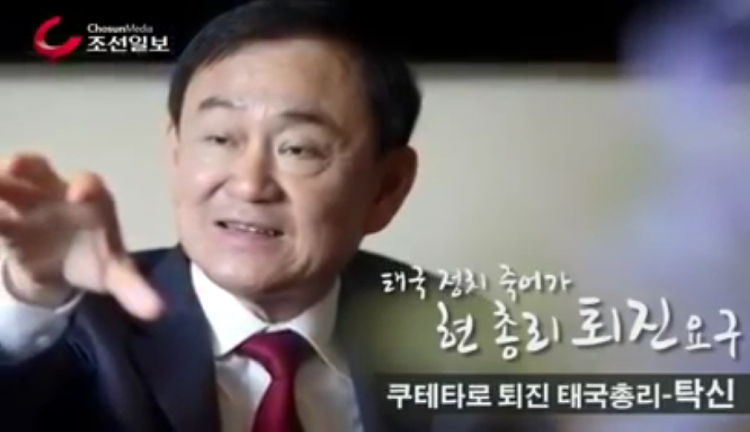
Charges of lèse-majesté and violation of the Computer Crime Act against former PM Thaksin Shinawatra — the single most influential figure in Thai politics over the past two decades — were dismissed by the Criminal Court in Bangkok this morning. The charges related to a video interview that Thaksin gave in South Korea ten years ago: speaking to The Chosun Daily (조선일보), he implied that a “palace circle” was behind the 2014 coup.
Today, the court ruled that Thaksin’s interview did not constitute lèse-majesté, as he had not singled out any specific individual for criticism. The verdict followed the letter of the lèse-majesté law, and the court did not detect any possible innuendo in Thaksin’s vague references to palace insiders. This is how the law should be applied, of course, though it’s in contrast to lèse-majesté cases involving less high-profile defendants, in which the law has been interpreted more broadly.
Thaksin’s passports were revoked by the Ministry of Foreign Affairs in 2015, in a preemptive decision pending a police investigation into the Chosun Daily video. Two days later, lèse-majesté charges were filed against him on behalf of Udomdej Sitabutr, army chief at the time (raising questions about the politicisation of the military). The case lay dormant for almost a decade, though it was reopened last year, following Thaksin’s return from self-imposed exile. He appeared at the Office of the Attorney General to answer the charges, and was then formally indicted. The long-running case has now been dropped.
Today, the court ruled that Thaksin’s interview did not constitute lèse-majesté, as he had not singled out any specific individual for criticism. The verdict followed the letter of the lèse-majesté law, and the court did not detect any possible innuendo in Thaksin’s vague references to palace insiders. This is how the law should be applied, of course, though it’s in contrast to lèse-majesté cases involving less high-profile defendants, in which the law has been interpreted more broadly.
Thaksin’s passports were revoked by the Ministry of Foreign Affairs in 2015, in a preemptive decision pending a police investigation into the Chosun Daily video. Two days later, lèse-majesté charges were filed against him on behalf of Udomdej Sitabutr, army chief at the time (raising questions about the politicisation of the military). The case lay dormant for almost a decade, though it was reopened last year, following Thaksin’s return from self-imposed exile. He appeared at the Office of the Attorney General to answer the charges, and was then formally indicted. The long-running case has now been dropped.