
Thailand has been in a state of political crisis for almost twenty years: a cycle of protests and military interventions, dominated by a populist politician (Thaksin Shinawatra, who won an election landslide in 2001) and a military dictator (Prayut Chan-o-cha, who led a coup in 2014 and remains Prime Minister). A new exhibition — Red, Yellow and Beyond — provides a photographic record of the last two decades, and the following is a concise guide to the major political events of this turbulent and polarising period.
Thaksin won an unprecedented second election victory in 2005, though protests against his administration began when he sold a stake in his Shin Corp. company to Singaporean company Temasek in 2006. His government had increased the legal limit on foreign ownership of telecom firms to enable the Shin sale, and changed the tax code to avoid paying any duty on the deal, a manipulation of the law for personal gain. The anti-Thaksin campaign disrupted the 2006 election, which was invalidated by the Constitutional Court.
Thaksin won an unprecedented second election victory in 2005, though protests against his administration began when he sold a stake in his Shin Corp. company to Singaporean company Temasek in 2006. His government had increased the legal limit on foreign ownership of telecom firms to enable the Shin sale, and changed the tax code to avoid paying any duty on the deal, a manipulation of the law for personal gain. The anti-Thaksin campaign disrupted the 2006 election, which was invalidated by the Constitutional Court.

The 2006 Coup and the People Power Party
Thaksin was deposed by a military coup in 2006. The junta drafted a new constitution, which was endorsed in a referendum. Whereas the previous 1997 ‘people’s charter’ had created a democratically elected Senate, under the new constitution only 50% of senators were elected and the remainder were appointed. Thaksin’s Thai Rak Thai party was dissolved by the Constitutional Court in 2007, and he was later convicted of corruption.
If the coup had been designed to eradicate Thaksin’s political influence, it was unsuccessful, as he formed the People Power Party as a proxy for Thai Rak Thai. The PPP won the 2007 election, though its leader Samak Sundaravej was disqualified from politics by the Constitutional Court on a technicality in 2008. Thaksin installed his brother-in-law, Somchai Wongsawat, as PPP leader to replace Samak, leading to a revival of the yellow-shirt People’s Alliance for Democracy anti-Thaksin campaign. The PAD occupied Bangkok’s airports and government buildings, and the Constitutional Court dissolved the governing PPP to appease the PAD protesters.
If the coup had been designed to eradicate Thaksin’s political influence, it was unsuccessful, as he formed the People Power Party as a proxy for Thai Rak Thai. The PPP won the 2007 election, though its leader Samak Sundaravej was disqualified from politics by the Constitutional Court on a technicality in 2008. Thaksin installed his brother-in-law, Somchai Wongsawat, as PPP leader to replace Samak, leading to a revival of the yellow-shirt People’s Alliance for Democracy anti-Thaksin campaign. The PAD occupied Bangkok’s airports and government buildings, and the Constitutional Court dissolved the governing PPP to appease the PAD protesters.

The Democrats and Pheu Thai
The court’s verdict created a power vacuum, and the military brokered a coalition between the opposition parties, led by Abhisit Vejjajiva’s Democrats, to form an unelected government. This prompted violent protests by the pro-Thaksin, red-shirt United Front for Democracy Against Dictatorship in 2009. Thaksin’s assets were frozen by the Supreme Court at the start of 2010, triggering UDD protest rallies. UDD protesters were brutally massacred by the military, and almost 100 people were killed.
Pheu Thai, another of Thaksin’s proxy parties, won the 2011 election, and Thaksin’s sister, Yingluck Shinawatra, became Prime Minister. Yingluck announced plans for an amnesty that would have quashed Thaksin’s corruption conviction. This sparked protests by the People’s Democratic Reform Committee, which — following the PAD playbook — quickly gathered steam. The PDRC blocked candidates from registering for the 2014 election, and sabotaged the election itself. The election was nullified by the Constitutional Court, and a rerun was scheduled for later that year. Yingluck was removed as PM by the Constitutional Court after an investigation into nepotism charges (and subsequently fined, impeached, and convicted of dereliction of duty — in absentia — in relation to her government’s rice subsidy scheme).
Pheu Thai, another of Thaksin’s proxy parties, won the 2011 election, and Thaksin’s sister, Yingluck Shinawatra, became Prime Minister. Yingluck announced plans for an amnesty that would have quashed Thaksin’s corruption conviction. This sparked protests by the People’s Democratic Reform Committee, which — following the PAD playbook — quickly gathered steam. The PDRC blocked candidates from registering for the 2014 election, and sabotaged the election itself. The election was nullified by the Constitutional Court, and a rerun was scheduled for later that year. Yingluck was removed as PM by the Constitutional Court after an investigation into nepotism charges (and subsequently fined, impeached, and convicted of dereliction of duty — in absentia — in relation to her government’s rice subsidy scheme).

The 2014 Coup
After Yingluck’s removal from office in 2014, the military imposed martial law and launched another coup two days later. Progressive politicians, including Yingluck, were detained, and protests were suppressed. After coup leader Prayut was appointed Prime Minister, sporadic anti-government demonstrations by young protesters began. Martial law, which had deterred widespread protests, was repealed in 2015. The junta rewrote the constitution in 2016, increasing proportional representation (to prevent another populist landslide) and reverting to a fully appointed Senate. The new charter, which was endorsed in a referendum, also gave senators a vote on who would become prime minister.
After numerous delays, an election was finally held in 2019. Another of Thaksin’s proxy parties, Thai Raksa Chart, audaciously nominated Princess Ubolratana as its candidate for prime minister in the election. On the same day, King Rama X issued a statement forbidding her from running for office. After this dramatic royal intervention, Thai Raksa Chart was dissolved by the Constitutional Court. Although Pheu Thai won the most seats in the election, Prayut was reinstated as Prime Minister.
After numerous delays, an election was finally held in 2019. Another of Thaksin’s proxy parties, Thai Raksa Chart, audaciously nominated Princess Ubolratana as its candidate for prime minister in the election. On the same day, King Rama X issued a statement forbidding her from running for office. After this dramatic royal intervention, Thai Raksa Chart was dissolved by the Constitutional Court. Although Pheu Thai won the most seats in the election, Prayut was reinstated as Prime Minister.

From Future Forward to Move Forward
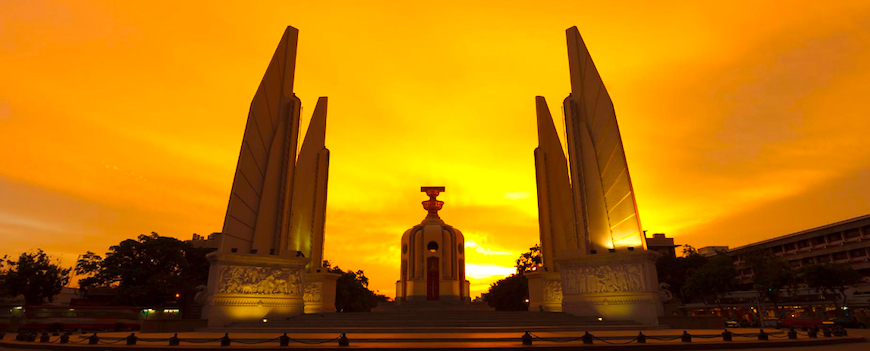
The current student-led protest movement began in 2020, following the dissolution of the Future Forward party by the Constitutional Court. Protest rallies organised by Free Youth and the United Front of Thammasat and Demonstration were held at Democracy Monument and Thammasat University, and riot police used water cannon to disperse protesters at Siam Square. In 2021, more radical protest groups such as REDEM (a rebranding of Free Youth) and Thalufah organised regular demonstrations near Victory Monument, and riot police began firing rubber bullets at the demonstrators.
Future Forward, previously led by Thanathorn Juangroongruangkit, was relaunched as Move Forward. As a popular alternative to the Thaksin-affiliated Pheu Thai, it may split the opposition vote in this year’s upcoming election, though a progressive coalition is also a possibility. Move Forward leader Pita Limjaroenrat is currently being investigated for ownership of shares in iTV, even though the TV station ceased operations in 2007. (Thanathorn was disqualified as an MP for ownership of media shares in 2019.)
A constitutional amendment in 2021 slightly reduced the impact of proportional representation on the election results; this may benefit larger parties such as Pheu Thai. A few months before the election, Prayut joined a new party, United Thai Nation, after a rift between him and his deputy, Prawit Wongsuwon (rumoured to be the mastermind behind the 2014 coup).
Future Forward, previously led by Thanathorn Juangroongruangkit, was relaunched as Move Forward. As a popular alternative to the Thaksin-affiliated Pheu Thai, it may split the opposition vote in this year’s upcoming election, though a progressive coalition is also a possibility. Move Forward leader Pita Limjaroenrat is currently being investigated for ownership of shares in iTV, even though the TV station ceased operations in 2007. (Thanathorn was disqualified as an MP for ownership of media shares in 2019.)
A constitutional amendment in 2021 slightly reduced the impact of proportional representation on the election results; this may benefit larger parties such as Pheu Thai. A few months before the election, Prayut joined a new party, United Thai Nation, after a rift between him and his deputy, Prawit Wongsuwon (rumoured to be the mastermind behind the 2014 coup).