
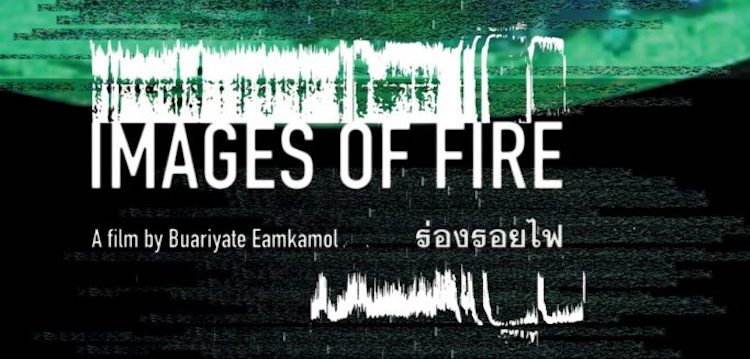
Buariyate Eamkamol’s short film Images of Fire (ร่องรอยไฟ) premiered yesterday at the What the Doc! 2 film festival. It will also be shown at Doc Club and Friends on 12th September.
The documentary, which examines the military crackdown on red-shirt protesters in April and May 2010, is both personal and political, forensic and philosophical. It begins self-reflexively, with Buariyate describing his research for the project: “I traveled to different locations in Bangkok. I searched for the spots where protesters were shot and the origin of the bullets.”
Many of the demonstrators were shot by snipers at long range, and Buariyate revisits the locations where several victims died, to determine where the armed soldiers were positioned. He locates the spot on Ratchaprarop Road where Samaphan Srithep was killed on 15th May 2010, and the entrance to Soi Sala Daeng where Chatchai Chalau died two days earlier.
Other recent short films have also returned to locations associated with the red-shirt crackdown: Weerapat Sakolvaree’s Nostalgia includes a sequence filmed at Lumpini Park, and Warat Bureephakdee’s Secret Among Wings (ความลับในฝูงนก) features shots of Ratchaprasong and Wat Pathum Wanaram. The Dutch artist Armando coined the phrase ‘guilty landscapes’ to describe spaces such as these, that bore silent witness to past violence. In both films, as in Images of Fire, the sounds of gunfire are heard on the soundtrack, a reminder of the events that took place at these guilty landscapes.
The documentary, which examines the military crackdown on red-shirt protesters in April and May 2010, is both personal and political, forensic and philosophical. It begins self-reflexively, with Buariyate describing his research for the project: “I traveled to different locations in Bangkok. I searched for the spots where protesters were shot and the origin of the bullets.”
Many of the demonstrators were shot by snipers at long range, and Buariyate revisits the locations where several victims died, to determine where the armed soldiers were positioned. He locates the spot on Ratchaprarop Road where Samaphan Srithep was killed on 15th May 2010, and the entrance to Soi Sala Daeng where Chatchai Chalau died two days earlier.
Other recent short films have also returned to locations associated with the red-shirt crackdown: Weerapat Sakolvaree’s Nostalgia includes a sequence filmed at Lumpini Park, and Warat Bureephakdee’s Secret Among Wings (ความลับในฝูงนก) features shots of Ratchaprasong and Wat Pathum Wanaram. The Dutch artist Armando coined the phrase ‘guilty landscapes’ to describe spaces such as these, that bore silent witness to past violence. In both films, as in Images of Fire, the sounds of gunfire are heard on the soundtrack, a reminder of the events that took place at these guilty landscapes.

As a child, Buariyate was taken to the protests by his father. Sixteen years later, as a filmmaker, he became especially interested in the case of Chatchai, who was recording a video when he was killed. Images of Fire considers the parallels between gunsights and camera viewfinders, and the link between proximity and empathy. As Buariyate says in the film: “Distance became a shield.” (Famously, in The Third Man, Harry Lime says that when seen from a distance, other people are just dots: “Would you really feel any pity if one of those dots stopped moving forever?”)
A viewfinder is a distancing device, just as a sniper operates at a literal distance from his target, and both guns and cameras can ‘shoot’ people. Thunska Pansittivorakul made that point in an interview for Thai Cinema Uncensored, discussing his experience of filming the crackdown on Soi Rangnam in May 2010: “they were shooting guns at the people... But at that time, I needed to keep shooting, I must keep shooting.”
Images of Fire also analyses audio clips of the gunfire, using the soundwaves to determine the types of bullets and their trajectories. One example is from 15th May 2010, when a man was shot in his car and his head slumped on the steering wheel, setting off the car horn. (The same recording is heard on Pisitakun Kuantalaeng’s album Kongkraphan, and Pisitakun also documented the locations at which other victims died for his Ten Year art project.)
With this investigative research — tracking down precise locations and sound clips — Buariyate questions the dominant narratives about 2010 told by the state, the media, and the red-shirts themselves. He includes TV news reports repeating government propaganda about “terrorists in the crowd”, showing how the protesters were demonised. In a voiceover, he notes that armed agitators (so-called ‘men in black’) were present at the demonstrations, despite the protesters’ insistence that they were peaceful. He even encourages skepticism about his own reliability as a narrator, by making a claim about his family that he later admits was false.
Images of Fire is Buariyate’s fourth film that touches on the 2010 violence, after A Fire 9 Kilometers Away, Isekai (อิเซไก), and Red Is the Orangest Colour. (Thai Cinema Uncensored discusses the representation of the April–May 2010 events by Thai filmmakers in more detail.)
A viewfinder is a distancing device, just as a sniper operates at a literal distance from his target, and both guns and cameras can ‘shoot’ people. Thunska Pansittivorakul made that point in an interview for Thai Cinema Uncensored, discussing his experience of filming the crackdown on Soi Rangnam in May 2010: “they were shooting guns at the people... But at that time, I needed to keep shooting, I must keep shooting.”
Images of Fire also analyses audio clips of the gunfire, using the soundwaves to determine the types of bullets and their trajectories. One example is from 15th May 2010, when a man was shot in his car and his head slumped on the steering wheel, setting off the car horn. (The same recording is heard on Pisitakun Kuantalaeng’s album Kongkraphan, and Pisitakun also documented the locations at which other victims died for his Ten Year art project.)
With this investigative research — tracking down precise locations and sound clips — Buariyate questions the dominant narratives about 2010 told by the state, the media, and the red-shirts themselves. He includes TV news reports repeating government propaganda about “terrorists in the crowd”, showing how the protesters were demonised. In a voiceover, he notes that armed agitators (so-called ‘men in black’) were present at the demonstrations, despite the protesters’ insistence that they were peaceful. He even encourages skepticism about his own reliability as a narrator, by making a claim about his family that he later admits was false.
Images of Fire is Buariyate’s fourth film that touches on the 2010 violence, after A Fire 9 Kilometers Away, Isekai (อิเซไก), and Red Is the Orangest Colour. (Thai Cinema Uncensored discusses the representation of the April–May 2010 events by Thai filmmakers in more detail.)