



Stephen Rebello wrote a thirty-page feature on the making of Psycho for Cinefantastique (vol. 16, no. 4–5), which he expanded into Alfred Hitchcock and the Making of Psycho, a book that set a benchmark for behind-the-scenes film monographs. There aren’t too many books about the making of films that actually become films themselves, but Rebello’s Psycho book was the basis for the biopic Hitchcock.
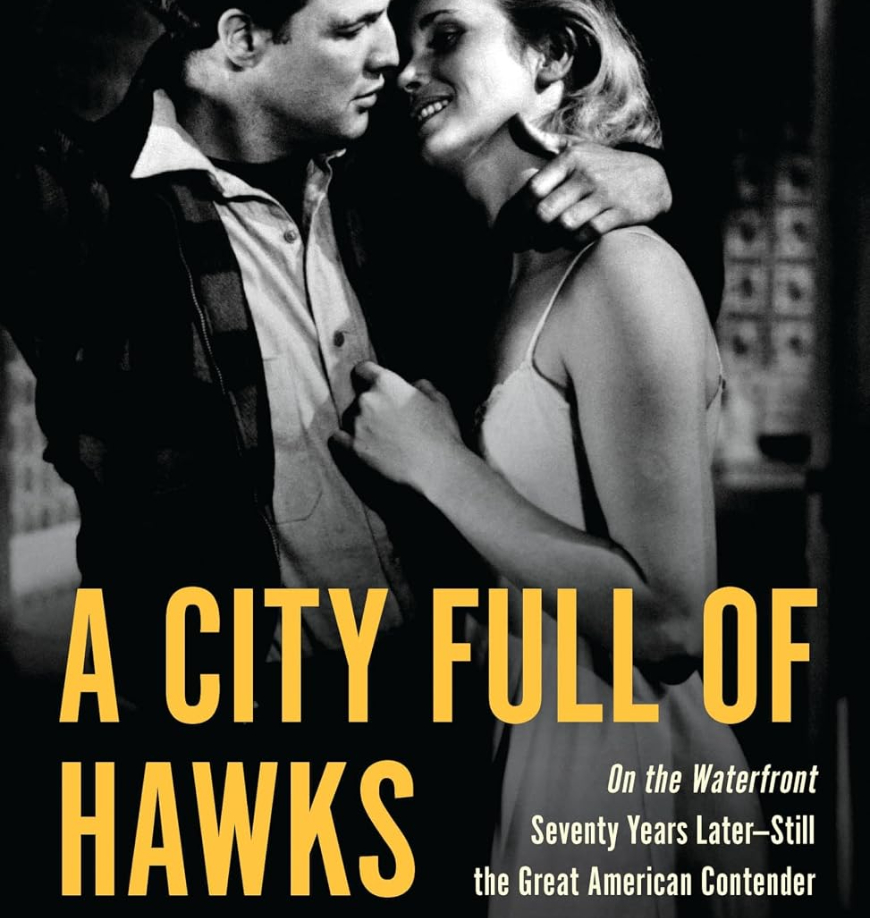
Rebello’s book A City Full of Hawks: On the Waterfront Seventy Years Later — Still the Great American Contender, published last year, covers the making of Elia Kazan’s On the Waterfront. As he says in his preface, the film is a five-star classic and Marlon Brando’s naturalistic performance in particular is one of the greatest in the history of cinema: “I hope to immerse you in every phase of the creation of one of the greatest, most important, and enduring movies ever made, featuring a towering central performance of such magnitude and genius that its impact and influence are still being felt today.”
Kazan directed Brando on stage and screen in A Streetcar Named Desire, but his reputation was tarnished in 1952 when he named names to the House Un-American Activities Committee, betraying former colleagues by identifying them as communists. On the Waterfront — in which Brando’s character Terry Malloy testifies to a crime commission — can be interpreted as Kazan’s defence of his HUAC testimony, and in the book’s final sentence Rebello concludes that Kazan’s betrayal was inexcusable.
Rebello’s book A City Full of Hawks: On the Waterfront Seventy Years Later — Still the Great American Contender, published last year, covers the making of Elia Kazan’s On the Waterfront. As he says in his preface, the film is a five-star classic and Marlon Brando’s naturalistic performance in particular is one of the greatest in the history of cinema: “I hope to immerse you in every phase of the creation of one of the greatest, most important, and enduring movies ever made, featuring a towering central performance of such magnitude and genius that its impact and influence are still being felt today.”
Kazan directed Brando on stage and screen in A Streetcar Named Desire, but his reputation was tarnished in 1952 when he named names to the House Un-American Activities Committee, betraying former colleagues by identifying them as communists. On the Waterfront — in which Brando’s character Terry Malloy testifies to a crime commission — can be interpreted as Kazan’s defence of his HUAC testimony, and in the book’s final sentence Rebello concludes that Kazan’s betrayal was inexcusable.
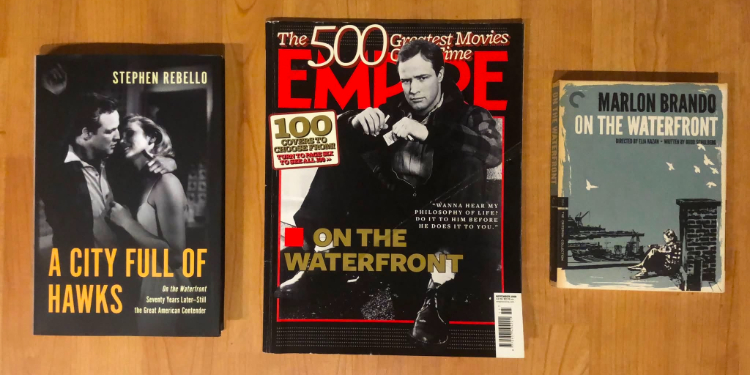
Kazan’s autobiography A Life includes his account of shooting On the Waterfront and Richard Koszarski’s recent Keep ’em in the East features a brief production history of the film, but A City Full of Hawks is the first full-length book on the making of On the Waterfront. Rebello describes the “dark comedy of bitterness, feuds, threats, physical violence, betrayals, jealousy, regret, recriminations, and occasionally, grace and camaraderie” that took place during the production, and the behind-the-scenes action was as dramatic as the film itself: “In fact, what happened during its 35 days of shooting is in many ways a movie all its own.”
A City Full of Hawks has a bibliography but no footnotes, and Rebello relies on his previous interviews with some of the key participants rather than archival research. The title and subtitle are both taken from lines spoken by Malloy: “You know this city’s full of hawks?” and, of course, his legendary monologue, “I coulda had class. I coulda been a contender. I coulda been somebody.”
On the Waterfront was shown at the Thai Film Archive earlier this year a part of their Blue Collar season. The film was released in a comprehensive blu-ray edition by the Criterion Collection.
A City Full of Hawks has a bibliography but no footnotes, and Rebello relies on his previous interviews with some of the key participants rather than archival research. The title and subtitle are both taken from lines spoken by Malloy: “You know this city’s full of hawks?” and, of course, his legendary monologue, “I coulda had class. I coulda been a contender. I coulda been somebody.”
On the Waterfront was shown at the Thai Film Archive earlier this year a part of their Blue Collar season. The film was released in a comprehensive blu-ray edition by the Criterion Collection.