


Almost 100 people were killed in 2010 when the government authorised the military to use live ammunition against red-shirt protesters. Nevertheless, artists such as Somsak Raksuwan focus only on the destruction of buildings and property, ignoring the suffering of the casualties and even demonising the victims themselves.
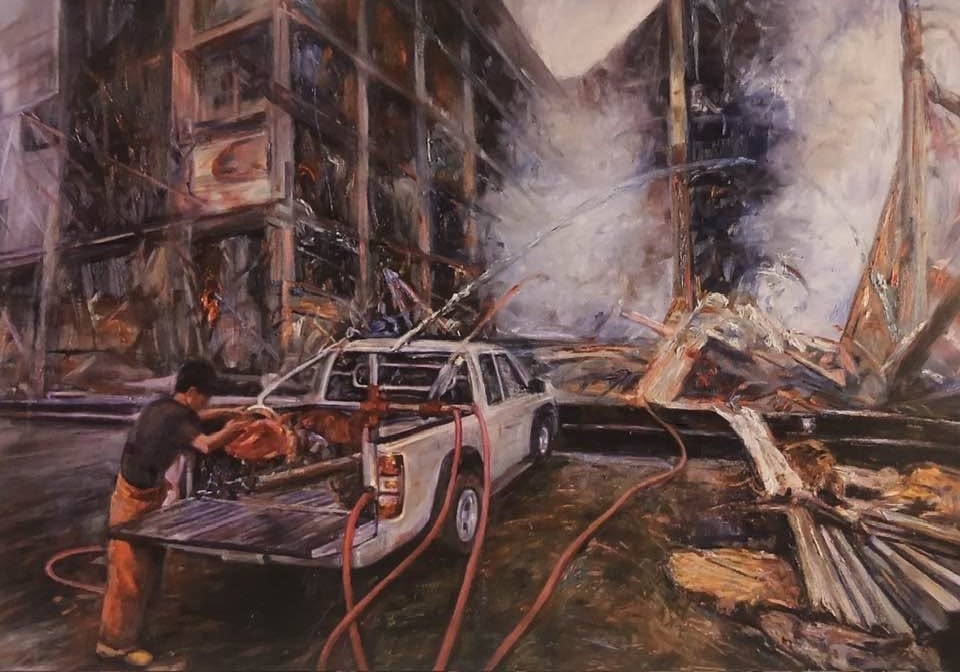
Somsak’s painting Event at Ratchaprasong (เหตุเกิดที่ราชประสงค์) has a euphemistic title that minimises the magnitude of the massacre that took place there. The painting depicts a firefighter in front of the ruins of the Zen department store, which was burnt on the evening of the army’s final crackdown against the protesters. Somsak seems to suggest that Zen was the real victim of the tragic event.
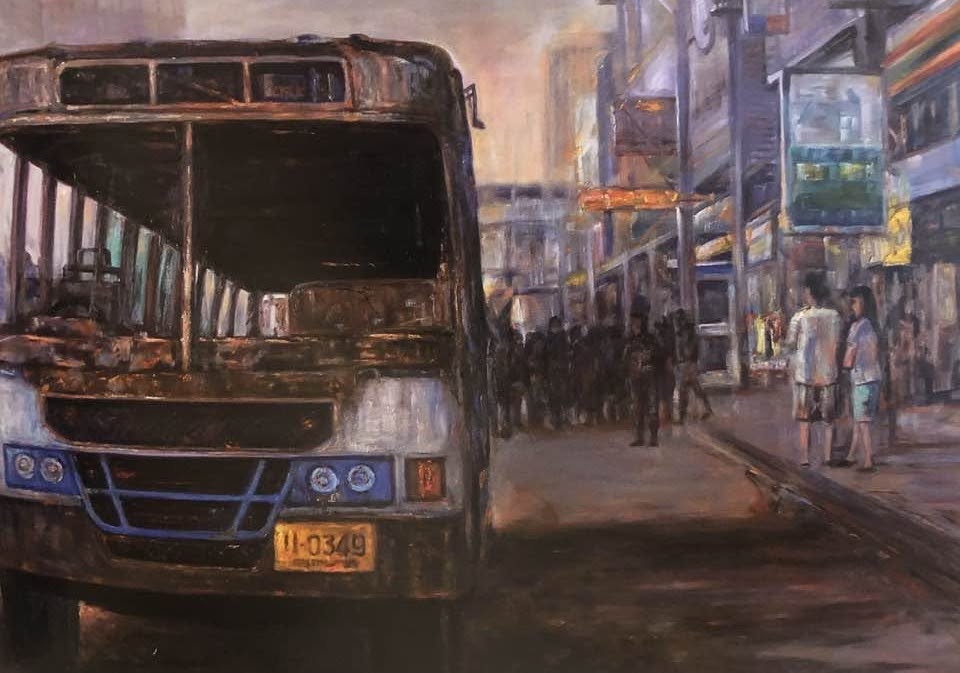
Similarly, another of his paintings, Who Did Burn Thai Bus? (รถเมล์ไทย ใครเผา), shows the burnt chassis of a public bus in Bangkok, and the title explicitly seeks to apportion blame for this act of arson. While, of course, setting fire to a bus is a crime, a more pertinent question might be: who did kill the protesters?
Somsak’s paintings were shown at his Thailand’s Democracy (ประชาธิปไตย ไทยแลนด์) exhibition at the PSG Gallery in Bangkok. Significantly, the exhibition was held from 20th November to 16th December 2013, coinciding with the start of the disruptive street protests against Yingluck Shinawatra’s government.
Somsak is not the only artist whose work in response to the 2010 massacre focuses only on the arson and property damage. The Rupture (หมายเหตุ ๕/๒๕๕๓) exhibition featured photographs by Olivier Pin-Fat, Wolfgang Bellwinkel, Piyatat Hemmatat, and Manit Sriwanichpoom showing burnt buildings, plumes of smoke, and barricades of tyres. This created the false impression that the event had been a destructive riot perpetrated by the red-shirts. (All images of red-shirt victims, taken by Agnes Dherbeys, were removed from the exhibition by Bangkok Art and Culture Centre management.)
Right-wing publications have also whitewashed the deaths of the victims. For example, พฤษภาอำมหิต (‘savage May’), published by Kom Chad Luek (คมชัดลึก), focused almost entirely on the arson committed after the massacre. Likewise, the subtitle of a book by Suthep Thaugsuban, อย่าให้ใครเผาอีก (‘don’t let anyone burn [Thailand] down again’), presents the red-shirts as arsonists and terrorists.
Somsak’s painting Event at Ratchaprasong (เหตุเกิดที่ราชประสงค์) has a euphemistic title that minimises the magnitude of the massacre that took place there. The painting depicts a firefighter in front of the ruins of the Zen department store, which was burnt on the evening of the army’s final crackdown against the protesters. Somsak seems to suggest that Zen was the real victim of the tragic event.
Similarly, another of his paintings, Who Did Burn Thai Bus? (รถเมล์ไทย ใครเผา), shows the burnt chassis of a public bus in Bangkok, and the title explicitly seeks to apportion blame for this act of arson. While, of course, setting fire to a bus is a crime, a more pertinent question might be: who did kill the protesters?
Somsak’s paintings were shown at his Thailand’s Democracy (ประชาธิปไตย ไทยแลนด์) exhibition at the PSG Gallery in Bangkok. Significantly, the exhibition was held from 20th November to 16th December 2013, coinciding with the start of the disruptive street protests against Yingluck Shinawatra’s government.
Somsak is not the only artist whose work in response to the 2010 massacre focuses only on the arson and property damage. The Rupture (หมายเหตุ ๕/๒๕๕๓) exhibition featured photographs by Olivier Pin-Fat, Wolfgang Bellwinkel, Piyatat Hemmatat, and Manit Sriwanichpoom showing burnt buildings, plumes of smoke, and barricades of tyres. This created the false impression that the event had been a destructive riot perpetrated by the red-shirts. (All images of red-shirt victims, taken by Agnes Dherbeys, were removed from the exhibition by Bangkok Art and Culture Centre management.)
Right-wing publications have also whitewashed the deaths of the victims. For example, พฤษภาอำมหิต (‘savage May’), published by Kom Chad Luek (คมชัดลึก), focused almost entirely on the arson committed after the massacre. Likewise, the subtitle of a book by Suthep Thaugsuban, อย่าให้ใครเผาอีก (‘don’t let anyone burn [Thailand] down again’), presents the red-shirts as arsonists and terrorists.
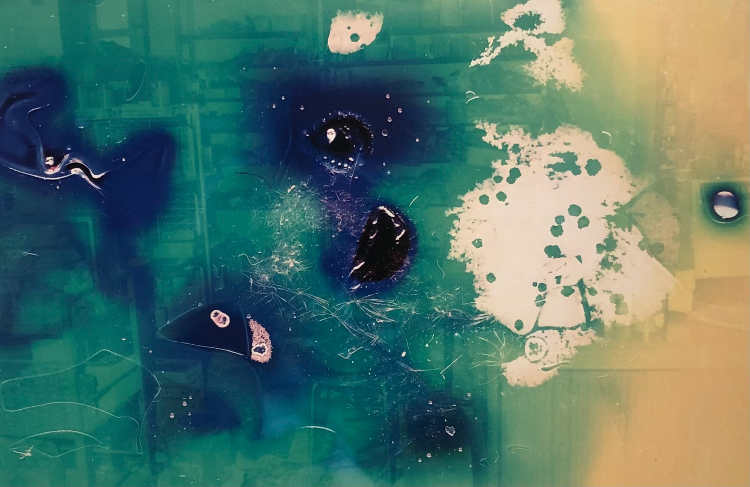
Kornkrit Jianpinidan’s 2024 photographic series Damage features photos of buildings looted and vandalised after a previous massacre on 6th October 1976, though the damage was caused by the perpetrators of the violence, not by the victims. (Damage will be shown at MAIIAM in Chiang Mai later this month, as part of an exhibition about the 1976 massacre.)