
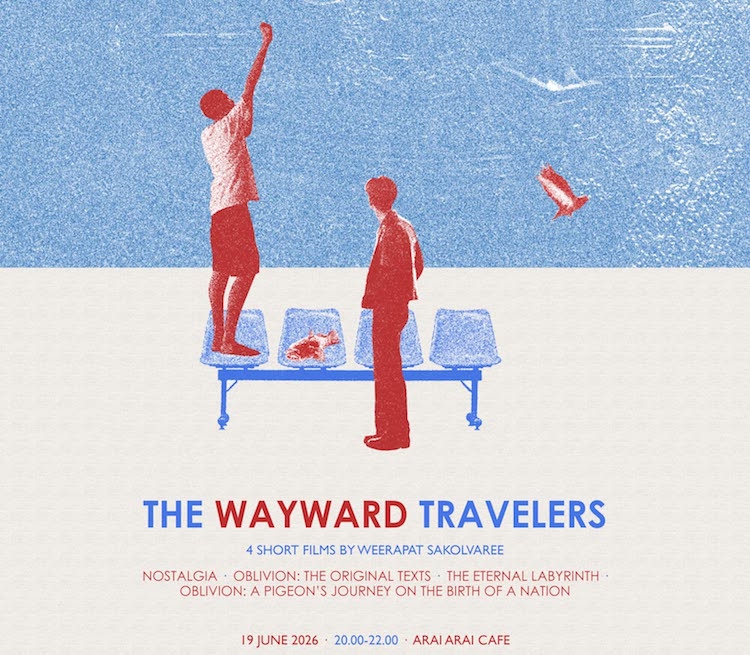
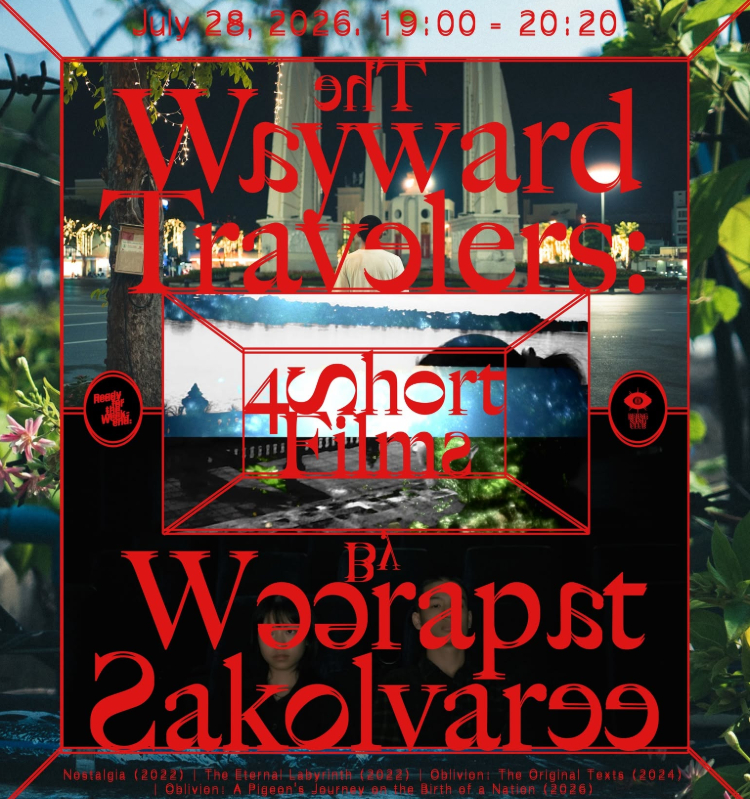
A retrospective of short films by Weerapat Sakolvaree will be shown on 19th June in the library at Arai Arai cafe in Bangkok, and on 28th July at the Ready for the Weekend coffee shop in Khon Kaen. The programme, The Wayward Travelers, features Nostalgia, The Eternal Labyrinth, and two films from Weerapat’s ongoing Oblivion (เลือน) series: The Original Texts (บทประพันธ์ดั้งเดิม) and A Pigeon’s Journey on the Birth of a Nation (ย้ายรัง). A previous Weerapat retrospective, the similarly-titled Trilogy of Wayward Travelers, was held in 2023.
Nostalgia
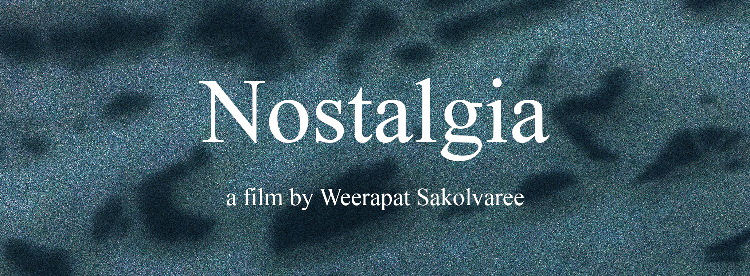
In Nostalgia, a young man discovers that, whenever he fires a shooting-star toy into the sky, he becomes receptive to sounds that regress progressively further into Bangkok’s violent past. Like Chris Marker’s La jetée (‘the jetty’), the ironically-titled Nostalgia is comprised of a series of still photographs, though it also includes archive newsreel footage of the 6th October 1976 massacre at Thammasat University.
Standing at the roadside in Din Daeng, the protagonist hears “fireworks and a lot of motorcycles.” These are sounds of the clashes between anti-government protesters and riot police that took place there throughout August 2021. (Police fired rubber bullets at protesters on 10th, 11th, 13th, and 15th August 2021.) At Siam Square, he hears the sound of riot police deploying water cannon against protesters on 16th October 2020. At Lumpini Park, the sound of the 19th May 2010 military crackdown fills his ears, followed by the ‘Black May’ 1992 massacre at Democracy Monument, and the 1976 Thammasat massacre.
These locations are, to use the Dutch artist Armando’s term, ‘guilty landscapes’: silent witnesses to past traumas. Like the origami bird in Panya Zhu’s White Bird (นกตัวนั้นยังสบายดีไหม), the toy in Nostalgia is a conduit for sonic echoes of historical violence, which form an audio collage in Weerapat’s film.
Nostalgia is also similar to Chai Chaiyachit and Chisanucha Kongwailap’s Re-presentation (ผีมะขาม ไพร่ฟ้า ประชาธิปไตย ในคืนที่ลมพัดหวน), which likewise revisits Bangkok’s ‘guilty landscapes’. Nostalgia and Re-presentation both end with shots of the Ananta Samakhom Throne Hall, hinting at the established hierarchies underlying Thai politics. In Nostalgia, the Throne Hall is seen from behind iron railings, a reminder that the building is now closed to the public.
Nostalgia has previously been shown at Nitade Experimental Shorts, at the Chiang Mai Film Festival (เทศกาลหนังแห่งเมืองเชียงใหม่) — twice — and at Future Fest 2023, Wildtype 2022, and The 26th Thai Short Film and Video Festival (เทศกาลภาพยนตร์สั้น ครั้งที่ 26). Its most recent screening was at The 7th Bangkok Experimental Film Festival (เทศกาลหนังทดลองกรุงเทพฯ ครั้งที่ 7) last year.
Standing at the roadside in Din Daeng, the protagonist hears “fireworks and a lot of motorcycles.” These are sounds of the clashes between anti-government protesters and riot police that took place there throughout August 2021. (Police fired rubber bullets at protesters on 10th, 11th, 13th, and 15th August 2021.) At Siam Square, he hears the sound of riot police deploying water cannon against protesters on 16th October 2020. At Lumpini Park, the sound of the 19th May 2010 military crackdown fills his ears, followed by the ‘Black May’ 1992 massacre at Democracy Monument, and the 1976 Thammasat massacre.
These locations are, to use the Dutch artist Armando’s term, ‘guilty landscapes’: silent witnesses to past traumas. Like the origami bird in Panya Zhu’s White Bird (นกตัวนั้นยังสบายดีไหม), the toy in Nostalgia is a conduit for sonic echoes of historical violence, which form an audio collage in Weerapat’s film.
Nostalgia is also similar to Chai Chaiyachit and Chisanucha Kongwailap’s Re-presentation (ผีมะขาม ไพร่ฟ้า ประชาธิปไตย ในคืนที่ลมพัดหวน), which likewise revisits Bangkok’s ‘guilty landscapes’. Nostalgia and Re-presentation both end with shots of the Ananta Samakhom Throne Hall, hinting at the established hierarchies underlying Thai politics. In Nostalgia, the Throne Hall is seen from behind iron railings, a reminder that the building is now closed to the public.
Nostalgia has previously been shown at Nitade Experimental Shorts, at the Chiang Mai Film Festival (เทศกาลหนังแห่งเมืองเชียงใหม่) — twice — and at Future Fest 2023, Wildtype 2022, and The 26th Thai Short Film and Video Festival (เทศกาลภาพยนตร์สั้น ครั้งที่ 26). Its most recent screening was at The 7th Bangkok Experimental Film Festival (เทศกาลหนังทดลองกรุงเทพฯ ครั้งที่ 7) last year.

The Original Texts
The Original Texts, a collage of found footage woven into a magical realist allegory, begins with the sound of gunshots, stills from Chookiat Sakveerakul’s film Taklee Genesis (ตาคลี เจเนซิส), and a voiceover in which a student, Burindh, describes the 1976 massacre: “A gunshot has been fired. Sending its vibrating wave upon my chest.”
As the poetic voiceover continues, the narrator recalls how he fled not only from the Thammasat campus but from Bangkok itself, which “is not the city of the people. It is not the city of ordinary people”. (These lines are juxtaposed with vintage newsreel footage of the Ananta Samakhom Throne Hall and the Grand Palace, symbolic buildings that also appear in Nostalgia and Zombie Citizens.)
As he escapes from his attackers, Burindh asks: “if I don’t possess this ideology that’s different than them, would they still aim their bullets at me?” The question is as relevant now as it was in 1976, as riot police fired rubber bullets at student protesters in 2021 and 2022. The film uses footage of a protest against Ampon Tangnoppakul’s conviction for lèse-majesté, taken from Apichatpong Weerasethakul’s short film Ashes, to hint at the ideology of Burindh and the recent protesters.
In 1976, a prominent monk, Kittivuddho Bhikku, pronounced that killing communists was equivalent to merely catching fish, in a signal to the royalist vigilante groups who stormed the Thammasat campus a few months later. Images of fish in Thunska Pansittivorakul’s documentary The Terrorists (ผู้ก่อการร้าย) were metaphors for the monk’s comments, though The Original Texts goes a stage further: Burindh transforms into a goby fish and swims away from Bangkok.
Burindh’s metamorphosis is similar to that of Boonsong, the monkey spirit in Apichatpong’s Uncle Boonmee Who Can Recall His Past Lives (ลุงบุญมีระลึกชาติ), another student who fled from persecution and transformed into an animal. Burindh meets Boonsong, his (literal) kindred spirit, who reassures him that his memories (and, by implication, Thailand’s political traumas) will not be forgotten as long as they are retold.
The Original Texts was directed under the pseudonym Burindh the Golden Goby. It was shown at Wildtype last year. The Original Texts and Nostalgia are both examples of films that refer to the Thammasat massacre, of which there are more than seventy titles. Thai Cinema Uncensored discusses Thai political filmmaking in much more detail.
As the poetic voiceover continues, the narrator recalls how he fled not only from the Thammasat campus but from Bangkok itself, which “is not the city of the people. It is not the city of ordinary people”. (These lines are juxtaposed with vintage newsreel footage of the Ananta Samakhom Throne Hall and the Grand Palace, symbolic buildings that also appear in Nostalgia and Zombie Citizens.)
As he escapes from his attackers, Burindh asks: “if I don’t possess this ideology that’s different than them, would they still aim their bullets at me?” The question is as relevant now as it was in 1976, as riot police fired rubber bullets at student protesters in 2021 and 2022. The film uses footage of a protest against Ampon Tangnoppakul’s conviction for lèse-majesté, taken from Apichatpong Weerasethakul’s short film Ashes, to hint at the ideology of Burindh and the recent protesters.
In 1976, a prominent monk, Kittivuddho Bhikku, pronounced that killing communists was equivalent to merely catching fish, in a signal to the royalist vigilante groups who stormed the Thammasat campus a few months later. Images of fish in Thunska Pansittivorakul’s documentary The Terrorists (ผู้ก่อการร้าย) were metaphors for the monk’s comments, though The Original Texts goes a stage further: Burindh transforms into a goby fish and swims away from Bangkok.
Burindh’s metamorphosis is similar to that of Boonsong, the monkey spirit in Apichatpong’s Uncle Boonmee Who Can Recall His Past Lives (ลุงบุญมีระลึกชาติ), another student who fled from persecution and transformed into an animal. Burindh meets Boonsong, his (literal) kindred spirit, who reassures him that his memories (and, by implication, Thailand’s political traumas) will not be forgotten as long as they are retold.
The Original Texts was directed under the pseudonym Burindh the Golden Goby. It was shown at Wildtype last year. The Original Texts and Nostalgia are both examples of films that refer to the Thammasat massacre, of which there are more than seventy titles. Thai Cinema Uncensored discusses Thai political filmmaking in much more detail.
