

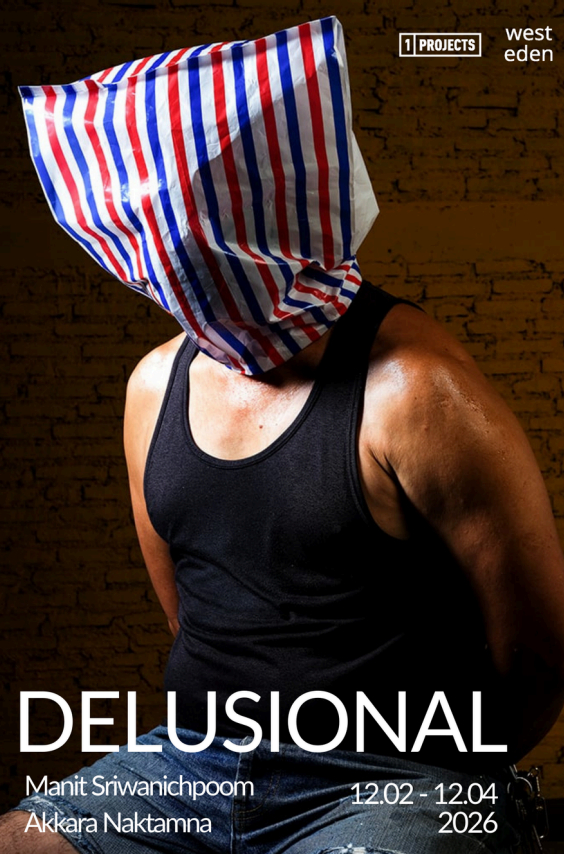
Delusional (หลงผิด), featuring new works by Manit Sriwanichpoom and Akkara Naktamna, opened yesterday at West Eden in Bangkok. The exhibition is the first in the gallery’s Shadow Archives series, and it runs until 12th April. Manit and Akkara will take part in a discussion at the gallery on 7th March.
Delusional examines “the suffocating realities of life” in a quasi-democratic system. Manit takes that description literally, with a series of photographs of people with bags covering their heads, titled Portraits of Thai Citizen (ภาพเหมือนบุคคลพลเมืองไทย). The bags have red, white, and blue stripes, the colours of the Thai flag.
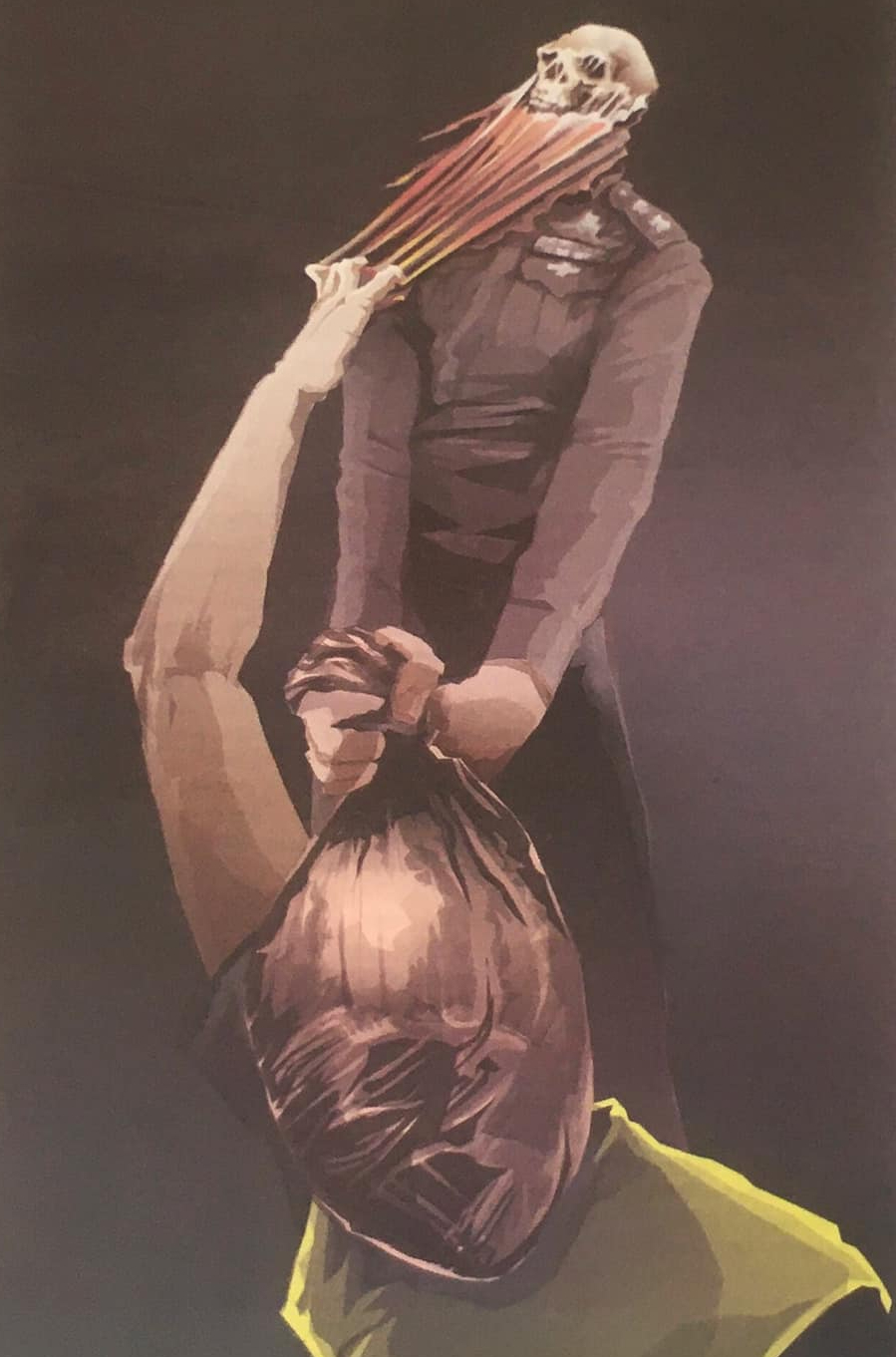
Beyond their metaphorical meaning, Manit’s images also refer to corrupt police chief Thitisan Utthanaphon, who murdered drug suspect Jeerapong Thanapat by suffocating him during an interrogation. The exhibition includes a CCTV video of the incident (ironically retitled How to Become a Thai Citizen), which made headlines in 2021. The killing also inspired a powerful cartoon by Arun Watcharasawad in Matichon Weekly (มติชนสุดสัปดาห์; vol. 42, no. 2142).
Delusional examines “the suffocating realities of life” in a quasi-democratic system. Manit takes that description literally, with a series of photographs of people with bags covering their heads, titled Portraits of Thai Citizen (ภาพเหมือนบุคคลพลเมืองไทย). The bags have red, white, and blue stripes, the colours of the Thai flag.
Beyond their metaphorical meaning, Manit’s images also refer to corrupt police chief Thitisan Utthanaphon, who murdered drug suspect Jeerapong Thanapat by suffocating him during an interrogation. The exhibition includes a CCTV video of the incident (ironically retitled How to Become a Thai Citizen), which made headlines in 2021. The killing also inspired a powerful cartoon by Arun Watcharasawad in Matichon Weekly (มติชนสุดสัปดาห์; vol. 42, no. 2142).
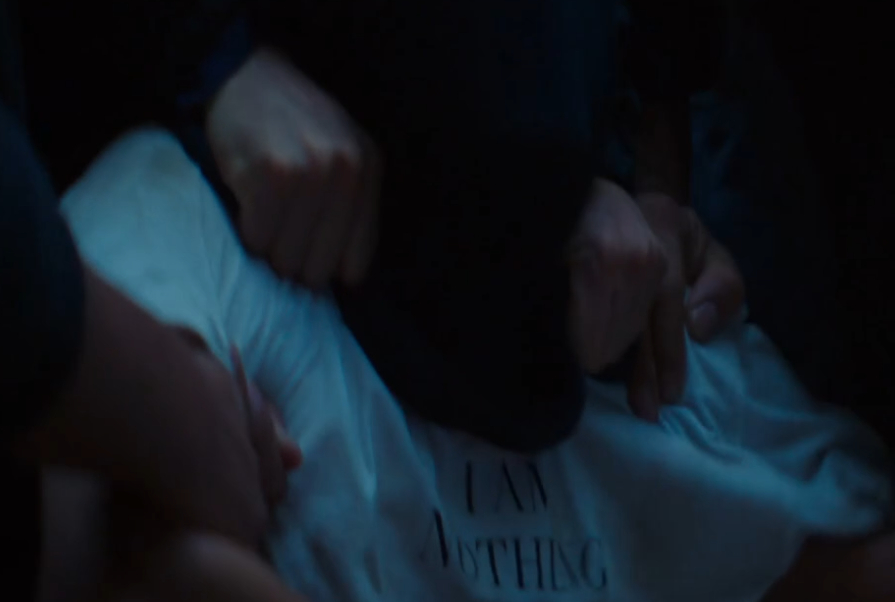
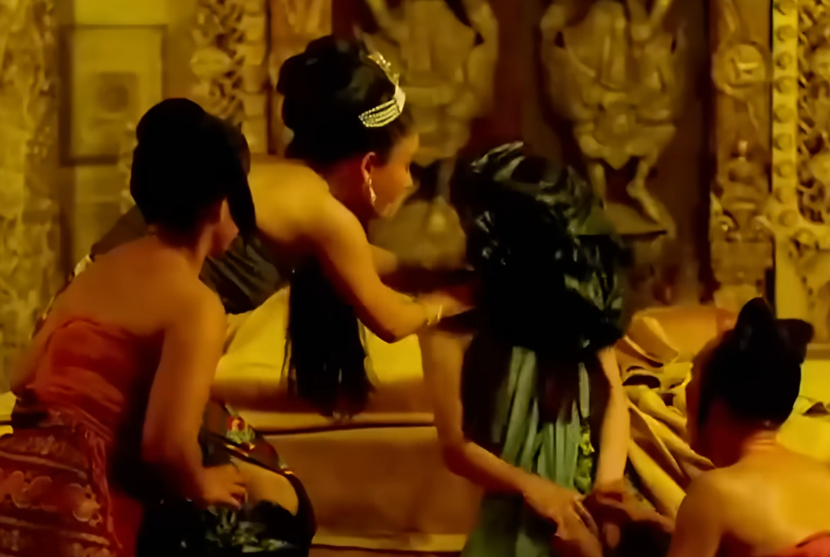
The Thitisan case has previously been referenced in two very different films. In the audacious opening sequence of Nontawat Numbenchapol’s Doi Boy (ดอยบอย), a cop with a guilty conscience has flashbacks of himself suffocating an anti-government protester. In contrast, Poj Arnon’s Oh My Ghost! 8 (หอแต๋วแตกแหก โควิดปังปุริเย่) includes a tasteless and offensive scene in which the suffocation is played for laughs by a group of aristocratic women.

Delusional also features Akkara’s Failing Dreams (ล้มฝัน) and Felling Dreams (ฝันล้ม). Failing Dreams is a series of thirteen photographs of Democracy Monument, the images distorted due to interference in a television signal. The implication is that tapping the TV set would briefly rectify the picture, just as protests and elections attempt to restore democracy.
Other artists — Suwaporn Worrasit’s short film Ratchadamnoen Route View 2482+, for example — have used images of Democracy Monument under construction as a metaphor for incomplete democracy, though Failing Dreams goes a stage further. The nearest equivalent to Failing Dreams is perhaps Thunsita Yanuprom and Sarun Channiam’s short film Democrazy.mov, in which a cellphone signal is jammed by a 44GHz frequency, a reference to article 44 of the 2014 interim constitution, which granted absolute power to the leaders of the 2014 coup.
Other artists — Suwaporn Worrasit’s short film Ratchadamnoen Route View 2482+, for example — have used images of Democracy Monument under construction as a metaphor for incomplete democracy, though Failing Dreams goes a stage further. The nearest equivalent to Failing Dreams is perhaps Thunsita Yanuprom and Sarun Channiam’s short film Democrazy.mov, in which a cellphone signal is jammed by a 44GHz frequency, a reference to article 44 of the 2014 interim constitution, which granted absolute power to the leaders of the 2014 coup.


There have been thirteen successful coups in Thailand, and Felling Dreams features photos of the thirteen coup leaders shown on a TV screen. This not only hints at the source of the interference from Failing Dreams, it also refers to television as the traditional medium used to announce Thai coups. (Natthapol Kitwarasai’s short film Coup d’état also includes photos of each coup leader.)