
29 November 2012
The Sun
Louis Walsh has been awarded £400,000 in an out-of-court settlement against The Sun newspaper. Walsh had sued The Sun for defamation after it falsely reported that he had groped Leonard Watters at a nightclub. The story, headlined "Louis probed over 'sex attack' on man in loo", was published on 23rd June 2011, and Watters was jailed for six months after he reported the fictitious incident to police.
28 November 2012
“It’s extremely regrettable that names may have been very briefly visible...”
Alistair McAlpine has received damages from both ITV and the BBC after he was linked to a rumoured paedophile network. McAlpine was paid £185,000 by the BBC and £125,000 by ITV in libel damages. The BBC’s Director General has resigned as a result of the controversy.
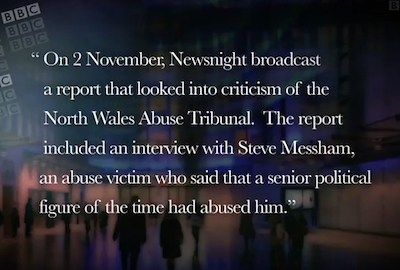
On 2nd November, BBC2’s Newsnight broadcast a report featuring an interview with Steven Messham, who claimed to have been sexually abused as a child. The report did not name McApline as Messham’s abuser, though it did refer to “a prominent Tory politician at the time”.
On ITV1’s This Morning on 8th November, presenter Phillip Schofield claimed to have found a list of alleged paedophiles online, and handed Prime Minister David Cameron “the names on a piece of paper”. The list, which included McAlpine’s name, was visible for a split second while Schofield was holding it.
On ITV1’s This Morning on 8th November, presenter Phillip Schofield claimed to have found a list of alleged paedophiles online, and handed Prime Minister David Cameron “the names on a piece of paper”. The list, which included McAlpine’s name, was visible for a split second while Schofield was holding it.
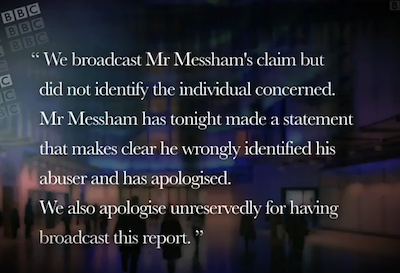
Newsnight broadcast an apology on 9th November: “Mr Messham has tonight made a statement that makes clear he wrongly identified his abuser and has apologised. We also apologise unreservedly for having broadcast this report.” This Morning broadcast an apology on the same day: “It’s extremely regrettable that names may have been very briefly visible as a result of a misjudged camera angle”.
BBC Director General George Entwistle was interviewed by John Humphrys on BBC Radio 4’s Today programme on 10th November. Entwistle said that the Newsnight report was not brought to his attention until the day after it was broadcast, and he had not read news about it on Twitter or in the press.
An incredulous Humphrys replied: “You’ve no natural curiosity? You wait for someone to come along to you and say, ‘Excuse me, Mr Director General, but this is happening and you may be interested’, you don’t look for yourself, you don’t do what everybody else in the country does: read newspapers, listen to everything that’s going on”. Entwistle resigned later that day.
BBC Director General George Entwistle was interviewed by John Humphrys on BBC Radio 4’s Today programme on 10th November. Entwistle said that the Newsnight report was not brought to his attention until the day after it was broadcast, and he had not read news about it on Twitter or in the press.
An incredulous Humphrys replied: “You’ve no natural curiosity? You wait for someone to come along to you and say, ‘Excuse me, Mr Director General, but this is happening and you may be interested’, you don’t look for yourself, you don’t do what everybody else in the country does: read newspapers, listen to everything that’s going on”. Entwistle resigned later that day.
26 November 2012
Corpus Christi

The play is set in Texas, and was performed there in 2001. It was staged in London the year before. More recently, it was revived in New York in 2008, and even performed at a church in Cameron Park, California, in 2009. Its script was published in 1999.
Jesus has previously been portrayed as gay in Fernando Bayona's photographic series Circus Christi, Matthias von Fistenberg's film Passio, Ed D Louie's film He, James Kirkup's poem The Love That Dares To Speak Its Name, Enrique Chagoya's lithograph The Misadventures Of The Romantic Cannibals, and Johnny Correa's illustration Resurrection (in The Insurgent). Also, in Jerry Springer: The Opera, Jesus admits: "Actually, I am a bit gay". Kittredge Cherry's book Art That Dares examines other homoerotic representations of Jesus.
23 November 2012
Mekong Hotel

The film stars two of Apichatpong's most frequent collaborators, Jenjira Pongpas and Sakda Kaewbuadee, who previously appeared together in the short films Luminous People, Morakot, The Anthem, and My Mother's Garden. The actors play partly fictionalised versions of themselves: the film is set near Jenjira's actual home, and she discusses her real-life memories and future plans. The documentary tone is set by the opening scene, in which Apichatpong auditions composer Chai Dhatana - a sequence later that was later expanded into a short film, Sakda.
Like Apichatpong's earlier short film Morakot, the eponymous Mekong hotel is a haunted guesthouse. A 'pob' spirit possesses each of the characters, briefly turning them into cannibals. Several of Apichatpong's previous films, notably Tropical Malady and Uncle Boonmee, have also featured spirits, though here the ghosts are surprisingly corporeal. Jenjira's character, for example, is revealed to be 600 years old, though she is portrayed as realistically as the similar 'ghost' in Pedro Almodovar's Volver.
As in Uncle Boonmee, the sense of magical realism is uncanny (in the Freudian sense) and sometimes comical. The characters seem to exist in several parallel universes: Sakda (who starred in Syndromes & A Century) plays at least three different people (a young man seducing his female neighbour, an old man with a different name, and a young gay man), though outwardly he always looks exactly the same. Again, this recalls Uncle Boonmee, in which Sakda and Jenjira have an out-of-body experience.
Mekong Hotel looks entirely naturalistic, with medium-shots, long takes, and no camera movement (inspired by Yazujiro Ozu?). The dialogue sequences are punctuated by long-shots of the river and its surrounding landscape, accompanied by Chai's guitar soundtrack.
15 November 2012
Encounter Thailand

My debut feature for Encounter Thailand magazine, Thai Movie Censorship, is published in the October issue (vol. 1, no. 7, pp. 38–39). The article examines films cut and banned in Thailand, and includes an interview with director Thunska Pansittivorakul.

14 November 2012
Bangkok Design Festival 2012


ASEAN Horror Film Festival


13 November 2012
100 Ideas That Changed Photography

Marien follows the same format as 100 Ideas That Changed Film, an earlier entry in the series: 100 chapters, each with a single page of text accompanied by a full-page photograph. There are chapters devoted to a variety of camera types, photographic mediums, and genres, most of which are analogue rather than digital. There are also entries for different methods of photographic distribution, such as postcards, tabloids, and photo-sharing.
The book feels like an expanded version of The Visual Dictionary Of Photography, or a concise version of The Focal Encyclopedia Of Photography. The emphasis is on technology more than the art of the medium (in contrast to Photographers A-Z). A World History Of Photography (Naomi Rosemblum), The History Of Photography (Beaumont Newhall), and The History Of Photography (Helmut Gernsheim) have more historical context, though 100 Ideas That Changed Photography is useful as an overview of the subject.
08 November 2012
The Godfather:
The Official Motion Picture Archives

The Godfather: The Official Motion Picture Archives, by Peter Cowie, examines the making of Francis Ford Coppola’s film The Godfather. It’s less than 100 pages long, though it includes removable facsimiles of various documents related to the film’s production and marketing.
The book’s chapters are fairly superficial. Fortunately, the detachable documents, including brochures and posters, are more impressive than the text. Cowie’s earlier account, The Godfather Book, is a more in-depth study of the film, and The Annotated Godfather is also more substantial. (Unlike those two earlier works, this new book contains no contribution from Coppola.)
The book’s chapters are fairly superficial. Fortunately, the detachable documents, including brochures and posters, are more impressive than the text. Cowie’s earlier account, The Godfather Book, is a more in-depth study of the film, and The Annotated Godfather is also more substantial. (Unlike those two earlier works, this new book contains no contribution from Coppola.)