
27 July 2026

Hearing the Voice of the Absence


Hearing the Voice of Absence

Hearing the Voice of the Absence (สดับเสียงที่ขาดหาย), a three-day programme of open-air film screenings, will take place in Chiang Mai next month. Highlights include the classic Tongpan (ทองปาน) and two recent short films, Apichatpong Weerasethakul’s Night Colonies and Anocha Suwichakornpong’s Narrative.

Tongpan and Night Colonies will be shown in the first session, titled Landscape and the Order of Seeing, on 7th August. Narrative will be shown during the third session, Rehearsing the Chronicle, on 9th August.

Hearing the Voice of the Absence is the second in a series of events, An Open Draft — Asian Film Programmers Lab, set up by the Japan Foundation. The screenings will be held at Suan Anya in Chiang Mai from 7th to 9th August, and are organised by Dude, Movie.

Night Colonies

Night Colonies


Night Colonies, originally shown as part of the anthology film The Year of the Everlasting Storm, combines two of Apichatpong’s consistent themes — light and the natural world — as it features insects buzzing around neon lights. The film begins with a poem paying tribute to “distant friends, and those who had disappeared”, a reference to pro-democracy campaigners self-exiled or abducted following lèse-majesté charges.

The poem continues: “The young leaves unfold, flushed with memories in the year of the everlasting storm.” In addition to giving the portmanteau film its title, these lines are also a metaphor for the student protesters campaigning for political reform. In fact, the film’s soundtrack includes audio recorded at protests in Bangkok on 27th July and 20th August 2020.

Narrative

Narrative


Narrative is a prelude to Anocha’s forthcoming film Fiction, in which she will stage a fictional trial of those accused of sanctioning the military crackdown on red-shirt protesters in 2010. Witnesses and relatives of the victims take part in a workshop about their memories of the event, in three guided discussion sessions.

As in Anocha’s By the Time It Gets Dark, the process of making a film about a traumatic episode of state violence self-reflexively becomes part of the film itself. Anocha and her crew are shown filming the workshop, and this acts as a distancing device, to the extent that the speakers’ words are sometimes drowned out.

Tongpan

Tongpan


Tongpan is a realistic dramatisation of a seminar that took place in 1975, which was organised to debate the construction of the Pa Mong dam on the Mekong river. The eponymous central character is a farmer who lost his land due to a previous dam.

In the film, Sulak Sivaraksa makes an impassioned speech against the proposed dam: “Development only serves a few people in Bangkok... And what about the destruction of our country? The whole province of Loei will be flooded by this Pa Mong Dam.” Ultimately, the Pa Mong project was abandoned, though this was a Pyrrhic victory for environmental campaigners, as dozens of hydroelectric dams are currently under construction.

Tongpan was made during the brief period of political freedom after the collapse of a military dictatorship in 1973, though by the time filming had been completed in 1977, the military had seized power again, and the film was banned. Its prologue captures the optimism of 1973 (“A military junta fled into exile, and the students from the city went into the countryside to tell the farmers”), though this is contrasted by an epilogue that describes the return of military rule (“shortly after the shooting of this film, a violent coup d’etat of a magnitude never before seen in Thailand brought an end to Thailand’s three-year experiment with democracy”).

Tongpan has previously been shown at Noir Row Art Space, Cinema Oasis, Bangkok Art and Culture Centre, and the Thai Film Archive (most recently in 2024). It was also screened last year in Khon Kaen.

20 July 2026

Sarit Thanarat


Sarit Thanarat

Sarit Thanarat, military prime minister during the Cold War, died in December 1963. After his death, the floodgates opened, and exposés of his love life were rushed into print. His lovenest was a private residence nicknamed the ‘pink palace’ (วิมานสีชมพู; also the title of an unauthorised posthumous Sarit biography), and เมียน้อย 108 (‘108 mistresses’) printed a list of the concubines he entertained there.

Several other books — including อัลบั้มภาพชุดสีชมพู (‘pink album’), วิมานสวาท หลังกองพล ๑ (‘the palace of love behind the 1st infantry regiment’) and the similarly titled รังสวาทหลังพล 1, จอมพลของคุณหนูๆ (‘young ladies of the general’), แม่ม่ายผ้าขะม้าแดง (‘the widow in the red sarong’), and สาวม่ายในวิมานสีชมพู (‘widows in the pink palace’) — featured dossiers of photographs of his alleged lovers. The Daily News (เดลินิวส์) cartoon booklet การ์ตูนชุดแม่ม่ายผ้าขาวม้าแดง (‘the widows in the red sarong cartoon series’) also featured thinly-veiled portrayals of Sarit’s mistresses.

Song of the City Junta Connection

Almost fifty years later, the phrase ‘pink palace’ was censored by Channel 3 when it broadcast the lakorn คุณชายพุฒิภัทร (‘khun Chai Puttipat’) on 5th May 2013. In the third episode, a former military general played by Montree Jenuksorn (who slightly resembles Sarit) discussed his ‘pink palace’, though the sound was muted, presumably to avoid any possibility of a libel suit from Sarit’s descendents. (The novel on which the drama was based refers to Sarit more obliquely.)

Potential defamation also prevented director Banjong Kosallawat from making a semi-fictionalised Sarit biopic in 2002, which was to have been titled จอมพล (‘marshal’). Sarit did feature briefly in the horror movie Zee Oui (ซี-อุย), ordering the swift execution of the murderous title character for political expediency. And Sarit’s statue looms ominously over the characters in Song of the City, Apichatpong Weerasethakul’s segment of the portmanteau film Ten Years Thailand.


The newsreel การปฏิบัติหน้าที่เพื่อประเทศชาติในตำแหน่งหัวหน้ารัฐบาลและผู้นำทางทหาร จนถึงล้มป่วยและอสัญกรรมของ ฯพณฯ จอมพลสฤษดิ์ ธนะรัชต์ (‘Field Marshal Sarit Thanarat performing duties for the country as the head of government and military leader until his illness and death’) is a fascinating example of Cold War state propaganda. Screened shortly after Sarit’s death, it provided a counter-narrative to the books that exposed his decadence and corruption. The film depicts Sarit as a tireless and selfless leader, to the extent that he became ill through overwork. Thunska Pansittivorakul’s recent documentary Isan Odyssey (อีสานอำพราง) gives the other side of the story, in a voiceover describing how suspected communists were “brutally murdered” during Sarit’s regime.


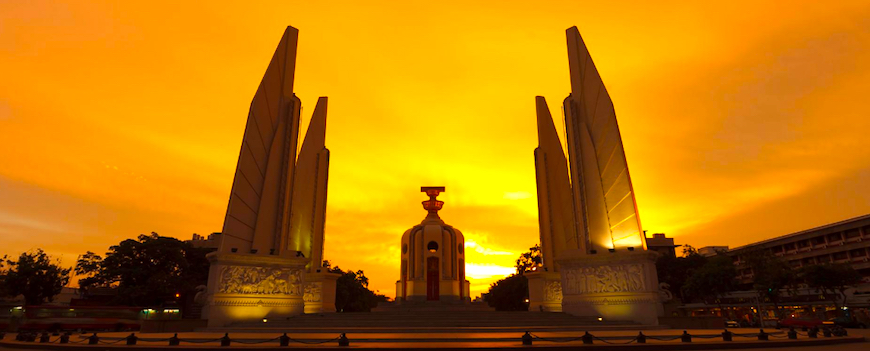
After Sarit led a coup in 1957, he was portrayed as a hero by pliant newspaper cartoonists. One example of such propaganda showed Sarit cradling a rescued child in his arms, returning the boy (who represents the Thai people) to his grateful mother. In contrast, a July 1958 cartoon in the liberal ประชาชน (‘people’) newspaper depicted Sarit as a monkey wrapping his tail possessively around Democracy Monument.

In the wake of the 2014 coup, Sarit satire was too sensitive, and the Guerrilla Boys self-censored their mural Junta Connection (วิ่งผลัดเผด็จการ), which originally depicted Sarit passing his (literal) baton of dictatorship to Prayut Chan-o-cha. Junta Connection was shown in 2018 as part of Khon Kaen Manifesto (ขอนแก่น แมนิเฟสโต้), a group exhibition that directly addressed Sarit’s contested legacy.

Art and Culture (ศิลปวัฒนธรรม) magazine analysed cartoonists’ caricatures of Sarit (vol. 43, no. 1), and the journal Same Sky (ฟ้าเดียวกัน) examined the lurid books published shortly after his death (vol. 20, no. 2). Thai Cinema Uncensored discusses the portrayal of Sarit in Thai films.

13 July 2026

A Romance… I Guess


A Romance... I Guess

Michael Haneke’s The Piano Teacher (La Pianiste) will be shown in Korat at the A Romance... I Guess (หนังรัก... ก็รักแหละ) film festival on 23rd August at the Korat Cineplex. (The festival runs from 14th to 23rd August.) The film has been rated ‘20’ by the censor board, and it’s the latest of several non-Thai films featuring explicit sex to be passed here uncut. Similarly, Dogtooth (Κυνόδοντας) and Pink Flamingos have also been rated ‘20’ uncensored.

A draft law to replace the Film and Video Act 2008, scrapping the state censorship board in favour of a system of industry self-regulation, was approved by the Pheu Thai cabinet in April last year, though the draft has yet to be approved by parliament, and remains in limbo. But in the meantime, the current members of the censor board have been intentionally selected for their progressive views, in keeping with recommendations for increasing soft power issued in 2024, hence the liberal approach to films like The Piano Teacher.

Songs of Angry People


Songs of Angry People

Uruphong Raksasad has directed a trilogy of documentaries about the recent student protest movement: Songs of Angry People, Paradox Democracy, and Cut of Speech. All have been shown at the Thai Film Archive in Salaya, though Songs of Angry People was deemed so sensitive that its screening — as part of To Commune, the 69th Flaherty Film Seminar programme in 2024 — wasn’t advertised in advance. Songs of Angry People was also shown in the Wildtype Middleclass programme this year, though the screenings were equally surreptitious, and it was listed as a ‘surprise film’ in the schedule.

In Paradox Democracy, speeches by protest leaders are intercut with extracts from The Revolutionist (คือผู้อภิวัฒน์), a play about Pridi Banomyong staged by the Crescent Moon theatre group in 2020. The film also includes footage shot at the 6th October 1976 commemorative exhibition at Thammasat University in 2020.

Cut of Speech concentrates almost exclusively on the protesters’ speeches. It features clips of forty-four speakers, in reference to article 44 of the interim constitution drafted after the 2014 coup.

Songs of Angry People does include short extracts from speeches by protest leaders — it begins with a fiery speech by Parit Chirawak outside the Crown Property Bureau offices — though it focuses more on the atmosphere of the protests. These include demonstrations at Democracy Monument, Din Daeng, and Nang Loeng in Bangkok, and at the smaller Democracy Monument in Khon Kaen.

Songs of Angry People

Songs of Angry People’s title comes from a comment by a protester to a phalanx of riot police: “Don’t make the people angry.” It also refers to the numerous protest songs performed at the demonstrations: Uruphong films Chaiamorn Kaewwiboonpan and the Bottom Blues performing 12345 I Love You, and The Commoner singing You Know Who (คนที่คุณก็รู้ว่าใคร) at Democracy Monument.

During the chorus of 12345 I Love You, demonstrators shout “ai hia Tu” instead of the original lyrics. (Ai hia is a strong insult, and Tu is Prayut Chan-o-cha’s nickname.) While Uruphong was filming Chaiamorn perform the song, his camera also caught sight of another director, Yuthlert Sippapak, who was coincidentally also filming the same performance. (Yuthlert was filming 1410, a project he announced with Chaiamorn in 2021.)

You Know Who

You Know Who was released as a single in 2021. Its lyrics refer to “He Who Must Not Be Named”, which is a description of Voldemort from the Harry Potter franchise. The music video ends with brief footage of the student protests, though its main theme is the discovery of the bodies of dissidents in the Mekong river.

The link between Harry Potter and the protest movement goes back to one of the first demonstrations in 2020, organised by Arnon Nampa at Democracy Monument. On 2nd August, on the eve of the sixth anniversary of that event, there will be another Harry Potter protest at the same location — ม็อบแฮรี่พอตเตอร์ ตอน จดหมายจากอัซคาบัน (‘Harry Potter mob: letter from Azkaban’) — held in solidarity with Arnon and other persecuted protest leaders.

10 July 2026

A Sudden Flicker of Light:
A Revisionist History of the Movies


A Sudden Flicker of Light

David Thomson has been described as the world’s greatest writer on film history, and his Biographical Dictionary of Film has been acclaimed as the greatest film reference book. Whether or not you agree with those opinions (I don’t), Thomson’s reputation means that any new book he writes deserves to be read.

A Sudden Flicker of Light: A Revisionist History of the Movies covers Hollywood, European silent cinema, and various national new wave movements. As anyone familiar with Thomson’s writing will be aware, the book is both authoritative and idiosyncratic. There are digressions of speculative fiction, asides to the reader, and unexpected references (to Tracey Emin, for example).

Thomson has previously written several similar books on the sweep of film history, most notably The Big Screen, a more conventional and satisfying account of the subject. His other books include Television, Have You Seen...?, Moments That Made the Movies, and The Moment of Psycho.

09 July 2026

Cinematic Nangloeng


Cinematic Nangloeng

Sala Chaloem Thani, Bangkok’s oldest cinema, reopened last year for a series of film screenings organised by the Thai Film Archive. More classics will be shown at the historic wooden cinema this year, in a Cinematic Nangloeng season that runs from 28th July to 1st August. Highlights include Somboonsuk Niyomsiri’s A Man Called Tone (โทน) on 29th July and Nonzee Nimibutr’s Dang Bireley’s and Young Gangsters [sic] (2499 อันธพาลครองเมือง) on 1st August.

A Man Called Tone

A Man Called Tone


The release of A Man Called Tone in 1970 was a turning point in Thai cinema history. Filmed in widescreen 35mm, it marked the end of the 16mm era, a formulaic mode of production that had dominated the industry for the previous twenty years. Stylistically, its modern approach to characterisation, acting, narrative, music, and cinematography was equally groundbreaking. It was previously shown at the Archive in 2025 and — to mark Somboonsuk’s ninetieth birthday — in 2023. It was also screened in 2022 at Doc Club and Pub in Bangkok, though a gala screening at the Scala cinema in 2020 was cancelled due to the coronavirus pandemic.

Dang Bireley's and Young Gangsters

Dang Bireley’s and Young Gangsters


Dang Bireley’s and Young Gangsters, the film that launched the Thai New Wave in 1997, was shown last year at the Microwave Film Festival in Sisaket. It had two outdoor screenings in 2022: in Chiang Mai (in 35mm) and Bangkok. It was shown at Scala in 2018, and at Ramada Plaza in 2010. It was shown twice at the Archive in 2020.

Like 1970, 1997 was a pivotal year for Thai cinema, as Dang Bireley’s and Young Gangsters broke domestic box-office records and Pen-ek Ratanaruang’s debut Fun Bar Karaoke (ฝันบ้าคาราโอเกะ) premiered at the Berlinale. The Bangkok Experimental Film Festival (เทศกาลหนังทดลองกรุงเทพฯ ครั้งที่) and Thai Short Film and Video Festival (เทศกาลภาพยนตร์สั้น) were also founded in that year.

07 July 2026

Barry Lyndon


Barry Lyndon

Stanley Kubrick’s classic Barry Lyndon will be shown at Sala Saneha in Bangkok on 5th, 8th, 12th, and 15th August. It was previously shown at GDXperience in May, and at Chulalongkorn University in 2023.

There has been a revival of critical interest in Barry Lyndon over the last decade, with three documentaries on the making of the film: the radio programme Castles, Candles, and Kubrick, an episode of the TV programme Hollywood in Éirinn, and Making Barry Lyndon on the Criterion blu-ray. There is also a book on the film, The Making of a Masterpiece, by Alison Castle.

05 July 2026

Morte Cucina


Morte Cucina

In Pen-ek Ratanaruang’s new thriller Morte Cucina, a waitress (Sao) notices a handsome man (Korn) who comes to eat at the restaurant where she works in Bangkok. As the proverb says, the way to a man’s heart is through his stomach: Korn is a gourmand, and Sao takes cooking classes, learning how to prepare lavish meals for him. Then Korn develops a mysterious illness...

In a subplot, a younger woman in Thailand’s deep south converts to Islam and gets married, though she is cast out of her community after they discover that she wasn’t a virgin. Later, we learn that she had been sexually assaulted by a drunk man on a beach.

The film doesn’t make any direct connections between these two scenarios, though the younger woman’s ordeals can be interpreted as flashbacks to Sao’s past. Sao tells Korn that she’s from Songkla (a southern province), and asks him if he has ever visited, and this apparent small talk implies that Sao was assaulted by Korn and disowned by her Muslim husband.

Korn becomes physically dependent on Sao as his health deteriorates, but they also seem to develop a mutual emotional dependency over the years that they spend together. This feels outdated, like the sexist storyline in Thai soap operas when a rich man rapes a woman but she forgives him and they fall in love.

Sao is slowly and methodically killing Korn with her cooking, in revenge for his drunken assault. But she always remains disapassionate, and there is no cathartic moment of confrontation. Perhaps that would have been too conventional? Instead, an unexpected final use of the dining table signals her empowerment. (I’m being ambiguous here to avoid spoilers.)

Morte Cucina comes almost twenty years after Pen-ek’s Ploy (พลอย), and both films include sex scenes with topless female nudity. Ploy was censored in 2007, and when I interviewed Pen-ek for Thai Cinema Uncensored, he explained that “they were afraid that in one of the cinemas we might show the uncut version. So, there were police everywhere.” In contrast, Morte Cucina has been released here uncut and rated ‘15’.

A minor footnote: Morte Cucina’s title, which literally translates as ‘death kitchen’ in Italian, is grammatically incorrect. Its Thai title is more prosaic: ครัวสาว (‘Sao’s kitchen’).

02 July 2026

นิรโทษกรรม จำเลยคดี 6 ตุลา
(‘amnesty for the 6th Oct. defendants’)


The documentary นิรโทษกรรม จำเลยคดี 6 ตุลา (‘amnesty for the 6th Oct. defendants’) will be shown at Thammasat University’s Faculty of Law on 5th July, as part of an event titled ครึ่งศตวรรษรัฐประหาร 6 ตุลาฯ ถึงเวลาลบมรดกบาป (‘half a century after the 6th Oct. coup, it’s time to erase the legacy of sin’). The film was previously screened at the Thai Film Archive in Salaya on 25th February 2017.

นิรโทษกรรม จำเลยคดี 6 ตุลา was compiled from news footage of the announcement in 1978 of an amnesty for the Thammasat students who were arrested following the 6th October 1976 coup. The amnesty was proposed by Kriangsak Chamanan, the de facto leader of another coup in 1977. In the film, Kriangsak is seen at a press conference with the students, which was held at his home, in a performative display of national unity and reconciliation.


Of course, the students were the surviving victims of the event, not the instigators of it, and the perpetrators — various right-wing paramilitary groups — never faced any charges. However, the documentary begins with a summary by Channel 7 that accuses the students of provoking the massacre, citing their reenactment of the hanging of two men arrested for campaigning against the return of former dictator Thanom Kittikachorn. The film shows the notorious photograph of that reenactment printed in the Dao Siam (ดาวสยาม) newspaper, and the student actor in the photo, Apinan Buahapakdee, was one of those who were charged before the amnesty was granted.

Thongchai Winichakul was also one of those charged and pardoned. In Moments of Silence, he wrote about his memories of attending the press conference at Kriangsak’s house, noting that the amnesty was presented not as the reversal of an injustice but as a pardoning of the students’ perceived offences: “throughout the entire encounter, Kriangsak treated us as the wrongdoers, such as by telling us not to repeat past mistakes. This definitely reflected his view, and possibly that of all of those in power as well.”


The documentary was one of six films about Kriangsak’s political career issued on VCD in 2006, collectively titled ที่ระลึกงานพระราชทานเพลิงศพ พลเอกเกรียงศักดิ์ ชมะนันท์ อดีตนายกรัฐมนตรี 12 พ.ย. 2549 (‘souvenir from the royal cremation ceremony of general Kriangsak Chamanan, former prime minister, 12th November 2006’). They were part of a commemorative box set given to those who attended his funeral.

Pulp Fiction


Skyline Film

Skyline Film will be showing Pulp Fiction at the Shanghai Mansion Bangkok hotel on 8th August. It was previously screened by Skyline in 2024, at River City Bangkok.

Pulp Fiction

Pulp Fiction has been shown in Bangkok several times before: at House Samyan in 2024, at Neighbourhood in 2023, at House Samyan and Bangkok Screening Room in 2019, and at Cinema Winehouse in 2018 and 2015. It was screened most recently at the Pavillion in May.

28 June 2026

Wildtype Middleclass 2026


Wildtype Middleclass 2026

Wildtype Middleclass 2026 will show a programme of independent and experimental films in July and August, at various microcinemas and other arts spaces around the country. Screenings will take place at Buffalo Bridge Gallery in Bangkok, Lorem Ipsum in Hat Yai, Alien Artspace in Khon Kaen (organised by Berng Nang Club), Chiang Mai University’s Department of Media Arts and Design (organised by Untitled for Film), Bliss Project in Chanthaburi, PYE Space in Phayao, and at Vongchavalitkul University’s Faculty of Communication Arts (organised by Doonungnaihognan) in Korat.

One of the highlights will be Sina Wittayawiroj’s Your Ash and My Bone (ธุลีดาว), which was previously shown at Sina’s exhibition Can’t We Recant? (เราจะถอนคำพูดไม่ได้เลยหรือ?) earlier this year in Khon Kaen and last year in Bangkok. Your Ash and My Bone is a documentary collage film in which the artist narrates his life story from birth to the present, from his family background to the progress of his artistic career. It will be screened at Buffalo Bridge, PYE Space, and Alien Artspace on 12th July; at Vongchavalitkul on 15th July; at CMU on 18th July; at Lorem Ipsum on 19th July; and at Bliss Project on 18th August.

There will also be a ‘surprise film’ directed by Uruphong Raksasad, screening at Buffalo Bridge, PYE Space, and Alien Artspace on 11th July; at Vongchavalitkul on 15th July; at CMU on 26th July; and at Bliss Project on 12th August. I don’t want to spoil the surprise here, except to say that it will be a rare opportunity to see a film that has been shown in Thailand only once before.

Your Ash and My Bone

Your Ash and My Bone


The film’s autobiographical narration is juxtaposed with an account of Thailand’s political turmoil over the same period. There is archive footage of ‘Black May’, the 2006 coup (which Sina describes as “this poisonous tree attempting to root itself deepest into society”), the red-shirt crackdown, the whistle-blower protests, the 2014 coup, and the student protest movement of 2020–2021.

Coloured filters are used to add political commentary to some of the events: blue for 2006, red for 2010, and yellow for 2014. Music is also a key element: a montage of scenes showing the arrest of Arnon Nampa and water cannon being used in Siam Square is accompanied by Caravan’s song Jit Phumisak (จิตร ภูมิศักดิ์), linking today’s student protesters to the revolutionary young writer who was killed in 1966.

Your Ash and My Bone also highlights some of Thailand’s artistic controversies over the past two decades: the banning of Apichatpong Weerasethakul’s Syndromes and a Century (แสงศตวรรษ), protests against Anupong Chantorn’s painting Perceptless (ภิกษุสันดานกา), and the censorship of the Rupture (หมายเหตุ ๕/๒๕๕๓) exhibition. The film shows how political repression and artistic censorship are equally corrosive.

Some self-censorship was necessary, and Sina draws attention to this by periodically displaying a spoof computer error screen (“No Freedom”) and obscuring certain words in the English subtitles. Abhichon Rattanabhayon used a similar tactic in his short film The Six Principles (สัญญาของผู้มาก่อนกาล), as did Pen-ek Ratanaruang in Paradoxocracy (ประชาธิป'ไทย).

27 June 2026

Gentlemen Prefer Blondes


Gentlemen Prefer Blondes

This month marks the centenary of Marilyn Monroe’s birth, and to celebrate the anniversary, the Thai Film Archive in Salaya will show one of her most famous films, Gentlemen Prefer Blondes, on 28th August. (The film was screened twice in Bangkok in 2017, at Scala and Bangkok Screening Room.)

Gentlemen Prefer Blondes is one of the essential Monroe films (alongside Some Like It Hot and The Seven Year Itch), purely because of her iconic performance of Diamonds Are a Girl’s Best Friend. (The sequence was the inspiration for Madonna’s Material Girl music video.)

14 June 2026

Disclosure Day


Disclosure Day

A new Steven Spielberg potential summer blockbuster was bound to be a highly anticipated release. But unfortunately, Disclosure Day doesn’t live up to the hype.

The chase sequences are unrealistic, with our heroes escaping completely unscathed in the nick of time. The sentimental Spielbergian elements — childhood homes, messages from cute animals, and even fairy tales — feel completely out of place in a film aimed at teenagers and adults. The alien imagery — Roswell and crop circles — is unoriginal.

Too much, including the conveniently all-powerful alien ‘device’, and the supposed North Korean nuclear threat, remains unexplained or underdeveloped. And the script is too clunky: Spielberg clearly wanted to highlight the importance of empathy, but he didn’t need to spell it out so directly.

11 June 2026

The Wayward Travelers


The Wayward Travelers

A retrospective of short films by Weerapat Sakolvaree will be shown on 19th June in the library at Arai Arai cafe in Bangkok, and on 28th July at the Ready for the Weekend coffee shop in Khon Kaen. The programme, The Wayward Travelers, features Nostalgia, The Eternal Labyrinth, and two films from Weerapat’s ongoing Oblivion (เลือน) series: The Original Texts (บทประพันธ์ดั้งเดิม) and A Pigeon’s Journey on the Birth of a Nation (ย้ายรัง). A previous Weerapat retrospective, the similarly-titled Trilogy of Wayward Travelers, was held in 2023.

The Wayward Travelers
Nostalgia

Nostalgia


In Nostalgia, a young man discovers that, whenever he fires a shooting-star toy into the sky, he becomes receptive to sounds that regress progressively further into Bangkok’s violent past. Like Chris Marker’s La jetée (‘the jetty’), the ironically-titled Nostalgia is comprised of a series of still photographs, though it also includes archive newsreel footage of the 6th October 1976 massacre at Thammasat University.

Standing at the roadside in Din Daeng, the protagonist hears “fireworks and a lot of motorcycles.” These are sounds of the clashes between anti-government protesters and riot police that took place there throughout August 2021. (Police fired rubber bullets at protesters on 10th, 11th, 13th, and 15th August 2021.) At Siam Square, he hears the sound of riot police deploying water cannon against protesters on 16th October 2020. At Lumpini Park, the sound of the 19th May 2010 military crackdown fills his ears, followed by the ‘Black May’ 1992 massacre at Democracy Monument, and the 1976 Thammasat massacre.

These locations are, to use the Dutch artist Armando’s term, ‘guilty landscapes’: silent witnesses to past traumas. Like the origami bird in Panya Zhu’s White Bird (นกตัวนั้นยังสบายดีไหม), the toy in Nostalgia is a conduit for sonic echoes of historical violence, which form an audio collage in Weerapat’s film.

Nostalgia is also similar to Chai Chaiyachit and Chisanucha Kongwailap’s Re-presentation (ผีมะขาม ไพร่ฟ้า ประชาธิปไตย ในคืนที่ลมพัดหวน), which likewise revisits Bangkok’s ‘guilty landscapes’. Nostalgia and Re-presentation both end with shots of the Ananta Samakhom Throne Hall, hinting at the established hierarchies underlying Thai politics. In Nostalgia, the Throne Hall is seen from behind iron railings, a reminder that the building is now closed to the public.

Nostalgia has previously been shown at Nitade Experimental Shorts, at the Chiang Mai Film Festival (เทศกาลหนังแห่งเมืองเชียงใหม่) — twice — and at Future Fest 2023, Wildtype 2022, and The 26th Thai Short Film and Video Festival (เทศกาลภาพยนตร์สั้น ครั้งที่ 26). Its most recent screening was at The 7th Bangkok Experimental Film Festival (เทศกาลหนังทดลองกรุงเทพฯ ครั้งที่ 7) last year.

The Original Texts

The Original Texts


The Original Texts, a collage of found footage woven into a magical realist allegory, begins with the sound of gunshots, stills from Chookiat Sakveerakul’s film Taklee Genesis (ตาคลี เจเนซิส), and a voiceover in which a student, Burindh, describes the 1976 massacre: “A gunshot has been fired. Sending its vibrating wave upon my chest.”

As the poetic voiceover continues, the narrator recalls how he fled not only from the Thammasat campus but from Bangkok itself, which “is not the city of the people. It is not the city of ordinary people”. (These lines are juxtaposed with vintage newsreel footage of the Ananta Samakhom Throne Hall and the Grand Palace, symbolic buildings that also appear in Nostalgia and Zombie Citizens.)

As he escapes from his attackers, Burindh asks: “if I don’t possess this ideology that’s different than them, would they still aim their bullets at me?” The question is as relevant now as it was in 1976, as riot police fired rubber bullets at student protesters in 2021 and 2022. The film uses footage of a protest against Ampon Tangnoppakul’s conviction for lèse-majesté, taken from Apichatpong Weerasethakul’s short film Ashes, to hint at the ideology of Burindh and the recent protesters.

In 1976, a prominent monk, Kittivuddho Bhikku, pronounced that killing communists was equivalent to merely catching fish, in a signal to the royalist vigilante groups who stormed the Thammasat campus a few months later. Images of fish in Thunska Pansittivorakul’s documentary The Terrorists (ผู้ก่อการร้าย) were metaphors for the monk’s comments, though The Original Texts goes a stage further: Burindh transforms into a goby fish and swims away from Bangkok.

Burindh’s metamorphosis is similar to that of Boonsong, the monkey spirit in Apichatpong’s Uncle Boonmee Who Can Recall His Past Lives (ลุงบุญมีระลึกชาติ), another student who fled from persecution and transformed into an animal. Burindh meets Boonsong, his (literal) kindred spirit, who reassures him that his memories (and, by implication, Thailand’s political traumas) will not be forgotten as long as they are retold.

The Original Texts was directed under the pseudonym Burindh the Golden Goby. It was shown at Wildtype last year. The Original Texts and Nostalgia are both examples of films that refer to the Thammasat massacre, of which there are more than seventy titles. Thai Cinema Uncensored discusses Thai political filmmaking in much more detail.

07 June 2026

The Lens of the Marginalized:
Documenting Identity and Blurred Borders


The 1st Lung Film Festival (ลุงฟิล์มเฟสติวัลครั้งที่ 1), taking place in Phatthalung from 4th to 26th July, will include a retrospective of films by Nontawat Numbenchapol. The Lens of the Marginalized: Documenting Identity and Blurred Borders (บันทึกตัวตนและพรมแดนที่พร่าเลือน), at the Us coffee shop, will feature all of Nontawat’s feature-length documentaries, including his early works Boundary (ฟ้าต่ำแผ่นดินสูง), By the River (สายน้ำติดเชื้อ), and Soil Without Land (ดินไร้แดน).

The director will take part in a Q&A on 12th July, titled The Longest Way Home: Nontawat Numbenchapol’s Journey Back to Self (การเดินทางกลับไปหาตัวตนของ นนทวัฒน์ นำเบญจพล). A previous Nontawat retrospective, Underdocs, was held in Bangkok in 2019.

Boundary

Boundary


Boundary documents the 2008 conflict between Thailand and Cambodia when the disputed Preah Vihear Temple was exploited for nationalist political gain. The issue was so sensitive that the director couldn’t even reveal his identity while filming at the temple. As he told me in an interview for Thai Cinema Uncensored: “I could not tell anyone in Cambodia that I’m Thai, because it would be hard to shoot. I had to tell everybody I’m Chinese-American... My name was Thomas in Cambodia.”

Boundary is composed largely of silent, still sequences depicting the serenity of rural life, as a counterpoint to the fierce border dispute surrounding the temple. Nontawat begins by interviewing Aod, a young soldier, in his home village. Idyllic sequences of novice monks bathing and Aod’s father fishing are contrasted with Aod describing his military conscription and the army’s crackdown against red-shirt protesters in 2010.

After footage of the Thai military firing at their Cambodian counterparts near Preah Vihear, we see damage to houses and a school close to the temple, caused by bombs and gunfire from Cambodian troops. Finally, at the end of the film, Nontawat’s camera explores the temple itself, the ruined Khmer compound that has been the subject of such bloodshed and ultra-nationalism.

It remains a topical film, as another border dispute between the two countries took place last year, and the issue was a significant factor in Bhumjaithai’s election victory in February. The Thai–Cambodia conflict also resulted in the dismissal of Paetongtarn Shinawatra as prime minister, following a leaked telephone call between Paetongtarn and former Cambodian PM Hun Sen, in which she appeared to side with Cambodia against her own military.

Boundary will be shown at LFF on 12th July. It was previously shown at Lido Connect and Warehouse 30 in Bangkok in 2019. It was screened four times last year: at Chiang Mai University, at Phimai, at the Thai Film Archive, and at Thammasat University. It has been subject to censorship twice: it was cut before its theatrical release in 2013, and a screening in Chonburi was prohibited by the military in 2015.

When Nontawat originally submitted the film to the censorship board, they announced that it had been banned, though two days later they performed a U-turn, explaining that the earlier announcement had been made by an unauthorised sub-committee. A token cut was required before the film was eventually approved by the censors: background audio of a crowd chanting “Long live the king!” at a New Year countdown was muted. Inexplicably, the film received a restrictive ‘18’ rating.

The censors had also argued that the film’s account of the 2010 military crackdown was misleading. A text caption in the film explains: “Almost 100 people were killed.” A comprehensive report by the People’s Information Center concluded that there were ninety-four casualties, which seems to validate the ‘almost 100’ claim, and ultimately the statistic was not cut from the film.

Initially unable to secure regular theatrical distribution, Nontawat was forced to negotiate with cinemas independently, selling tickets personally in the lobby of each venue. (Thai Cinema Uncensored covers the controversy surrounding the film’s release in more detail.)

By the River

By the River


By the River will be shown at LFF on 11th July. The film highlights the effects of lead pollution in the water of Lower Klity Creek in Kanchanaburi: when fishermen complained about poisoned fish, the local government simply told them to “find something else to eat.” As Nontawat explained in his Thai Cinema Uncensored interview: “This film is about toxins in the river. It captures the people who live around the river: their lives at that moment.”

The film’s subject is no less controversial than that of Boundary, as mining companies filed defamation lawsuits in 2016 and 2017 after similar investigations into water pollution. (The first case was dismissed, and the second was settled out of court.)

Soil Without Land

Soil Without Land


Soil Without Land’s LFF screening is on 12th July. Boundary explored the Thai-Cambodia border dispute through the experience of a newly conscripted soldier, and Soil Without Land takes a similar approach, documenting Jai Sang Lod’s conscription into the Shan State army. The Shan are persecuted in Myanmar, and are denied refugee status in neighboring Thailand.

The documentary is a precursor to Nontawat’s feature film Doi Boy (ดอยบอย), whose protagonist, Sorn, is also a young man from Shan State conscripted into the military. After deserting, Sorn crosses the border into Thailand, jumping from the frying pan into the fire. He is forced to totally transform his identity (from monk to soldier to sex worker) and, like other undocumented migrants in Thailand and elsewhere, he is exploited by almost everyone he meets.

06 June 2026

The 1st Lung Film Festival


The 1st Lung Film Festival

The 1st Lung Film Festival (ลุงฟิล์มเฟสติวัลครั้งที่ 1), organised by Phatthalung Micro Cinema, runs from 4th to 26th July, with screenings at the Us coffee shop in Phatthalung. The full schedule has not yet been announced — the LFF will feature a retrospective by Nontawat Numbenchapol — though the highlights so far include Vichart Somkaew’s short film Antipsychotics, his documentary When My Father Was a Communist (เมื่อพ่อผมเป็นคอมมิวนิสต์), and Wattanapume Laisuwanchai’s video installation The Body Craves Impact as Love Bursts (ร่างกายอยากปะทะ เพราะรักมันปะทุ).

When My Father Was a Communist is screening on 5th July. Antipsychotics and The Body Craves Impact as Love Bursts both feature in the Social Evolution (วิวัฒนาการสังคมไทย) programme on 18th July.

There will also be screenings of Stanley Kubrick’s 2001 (which opens the festival on 4th July) and The Shining (on 25th July), presented by Doc Club and Pub. Both films were shown at Cloud 11 in March, and have been screened in Thailand several times before.

Previous screenings of The Shining in Thailand: Previous Thai screenings of 2001:

Antipsychotics

Antipsychotics


At the start of Antipsychotics, Vichart reveals that he suffers from depression. In a voiceover, he describes his symptoms, which include hallucinations and feelings of paranoia. On screen, we see profiles of various antidepressant and antipsychotic drugs, and their possible side effects, accompanied by stock footage.

The director also recounts the traumatic experience that he feels led to his condition: the humiliating hazing rituals and violent punishments he endured during his conscription. “I drew a red card and was drafted into the military service”, he says, before describing the physical and mental harm he was subjected to.

There have been occasional news reports of cadets being injured — and worse — during military training sessions, though there is less coverage of the potential psychological toll that Vichart describes. At the end of his powerful and ultimately optimistic film, he argues that conscription should be replaced by voluntary service.

Antipsychotics will also be shown tomorrow at the Thailand International LGBTQ+ Film and TV Festival 2026. It has previously been screened at the Chard Festival (ฉาด เฟสติวัล), at Open Screen, and in last year’s Short Film Marathon (หนังสั้นมาราธอน).

When My Father Was a Communist

When My Father Was a Communist


For When My Father Was a Communist, Vichart interviewed his father, Sawang, and other former members of the Communist Party of Thailand. The film is a valuable social history, as the veterans explain their decisions to join the CPT, and describe their experiences in the forests of Phatthalung.

When My Father Was a Communist is also a record of the state’s violent suppression of communist insurgents, hundreds (potentially thousands) of whom were burned in oil drums in 1972. These so-called ‘red barrel’ deaths were most prevalent in Phatthalung, and have never been officially investigated. (The names of the victims are listed before the film’s end credits.) There have been other documentaries about the red barrels, but When My Father Was a Communist stands out for Vichart’s close connections to the subject: this is a deeply personal project, as he was born in Phatthalung, and he is documenting the memories of his elderly father.

The film has been screened around the country, including in Trang earlier this year, at last year’s Short Film and Video Festival (เทศกาลภาพยนตร์สั้น ครั้งที่), and at Hope Space in Bangkok.

The Body Craves Impact as Love Bursts

The Body Craves Impact as Love Bursts


The Body Craves Impact as Love Bursts features images of a man and woman tantalisingly close and facing each other, yet separated. As the director explained in his artist’s statement, the installation was made in solidarity with the rapper Elevenfinger, who served a prison sentence for possession of ping-pong bombs used in anti-government protests: “I have visited him and witnessed the despair not only affecting him and his partner but also their families and relatives. This situation mirrors the plight of other political prisoners”.

The video ends dramatically with flashing images and footage of fireworks, filmed at Thalugaz protests in 2021. It was first shown as an installation at the Procession of Dystopia exhibition. It has also been screened at The 7th Bangkok Experimental Film Festival (เทศกาลหนังทดลองกรุงเทพฯ ครั้งที่ 7), Can’t Stop Won’t Stop, Cinemine/d, and Phimailongweek (พิมายฬองวีค).

28 May 2026

Researching Film Censorship in Thailand


Research and Creation amid Asian Socio-political Sensitivity

I gave an online presentation — Researching Film Censorship in Thailand — for the Antwerp Research Institute for the Arts at the University of Antwerp in Belgium today. The event, Research and Creation amid Asian Socio-political Sensitivity: Methods and Reflections, was a seminar on film censorship in Asia, and I discussed the background to my book Thai Cinema Uncensored.

ARIA describes my session as follows: “Matthew Hunt will discuss the research process for his book “Thai Cinema Uncensored”, and the outcomes of that process. Challenges included a lack of cooperation from the Thai Ministry of Culture, and the initial reluctance of some directors to talk about their experiences of censorship. The interviews revealed a collective sense of political awakening among the directors, and a consistent set of grievances about the contemporary censorship system. However, the directors differed in their responses to censorship, depending on their commercial and ideological considerations, with some drawing attention and challenging the censors, while others worked under the radar. Previous accounts of Thai film censorship had cited the first film to be censored in the country (in 1923) and then jumped forward to 2007, ignoring the 80-year period in between. Filling in that gap involved an analysis of censorship policy over the last century, revealing its close connection to the country’s modern political history.”

Researching Film Censorship in Thailand

This is my how I’m described on the seminar’s website: “Matthew Hunt is the author of “Thai Cinema Uncensored”, the first history of film censorship in Thailand and the first comprehensive survey of Thai political filmmaking. In addition to his academic work, Hunt has been actively involved in journalism and cultural commentary. He was editor of the current affairs magazine Encounter Thailand, and has written magazine articles on the Thai film industry. He was also a lecturer at the Faculty of Communication Arts, Chulalongkorn University (Bangkok, Thailand), teaching courses on journalism and society. He has a master’s degree in visual culture from Coventry University (UK).”

This is the third online lecture I have given. The others, which were also about aspects of Thai cinema, were for the University of Wisconsin–Madison in 2021 and the Peace Research Institute Oslo in 2022.

27 May 2026

Thailand International LGBTQ+ Film and TV Festival 2026


Thailand International LGBTQ+ Film and TV Festival 2026

The Thailand International LGBTQ+ Film and TV Festival 2026 will be held at Paragon Cineplex in Bangkok from 5th–11th June. (TILFF was also held at Paragon in 2024, though last year the festival took place at Icon Siam.)

Vichart Somkaew’s Antipsychotics will be shown on 7th June as part of the Thai Spectrum programme. It has previously been screened at the Chard Festival (ฉาด เฟสติวัล), at Open Screen, and in last year’s Short Film Marathon (หนังสั้นมาราธอน).

Another Thai Spectrum strand, a programme of short films also screening on 7th June, has a self-imposed ‘18’ age rating, as it includes the explicit Thai films Peach (พีช) and Auey Kaab. Peach, an experimental film directed under the pseudonym Shadowplay, begins with a series of photos of male and female body parts shown as double-exposures. (The first image is of two erections.)

Auey Kaab (เอื้อยค้าบบบ), directed by Patthakarn Sadubtham and shot on Super 8mm film, features young Isan men having sex while wearing Songkran costumes. A humorous voiceover refers to the stereotype of Isan men who elicit money from people who fall for them by pretending that their buffalo is sick. Patthakarn has also produced a magazine with the same title, in collaboration with Oat Montien, featuring behind-the-scenes photos from the film.

Antipsychotics

Antipsychotics


At the start of Antipsychotics, Vichart reveals that he suffers from depression. In a voiceover, he describes his symptoms, which include hallucinations and feelings of paranoia. On screen, we see profiles of various antidepressant and antipsychotic drugs, and their possible side effects, accompanied by stock footage.

The director also recounts the traumatic experience that he feels led to his condition: the humiliating hazing rituals and violent punishments he endured during his conscription. “I drew a red card and was drafted into the military service”, he says, before describing the physical and mental harm he was subjected to.

There have been occasional news reports of cadets being injured — and worse — during military training sessions, though there is less coverage of the potential psychological toll that Vichart describes. At the end of his powerful and ultimately optimistic film, he argues that conscription should be replaced by voluntary service.

25 May 2026

เทศกาล หนังไทย...ต้องดู:
Thai Film Showcase #1


Wednesday Shine

Wednesday Shine, a microcinema in Chiang Mai, will show a season of classic Thai films from tomorrow until 4th June. The เทศกาล หนังไทย...ต้องดู: Thai Film Showcase #1 (‘Thai film festival...must see’) programme includes two films by Anocha Suwichakornpong: By the Time It Gets Dark (ดาวคะนอง) on 28th May and Mundane History (เจ้านกกระจอก) on 4th June.

The Edge of Daybreak


The Edge of Daybreak

Taiki Sakpisit’s The Edge of Daybreak will be shown on 31st May as part of the Hua Hin Indie Screen film programme at the Hua Hin Convention Center. The screening will be followed by a Q&A with Taiki, and Hua Hin Indie Screen runs from 29th to 31st May.

Like Sivaroj Kongsakul’s Regretfully at Dawn (อรุณกาล), Jakrawal Nilthamrong’s Anatomy of Time (เวลา), and Apichatpong Weerasethakul’s Uncle Boonmee Who Can Recall His Past Lives (ลุงบุญมีระลึกชาติ), The Edge of Daybreak’s protagonist is a retired soldier nearing the end of his life, who cannot escape the memories and consequences of his role in the suppression of communist insurgents. It begins with a flashback to that era, narrated by the old man: “I was leading my unit into the woods to catch the students.”

Hua Hin Indie Screen

In Taiki’s film, the former soldier’s family believe that they are cursed and, as if to confirm this, the exquisite black-and-white camerawork lingers on images of decay, such as rotting food and their crumbling home. The Edge of Daybreak was previously shown at the Chiang Mai Film Festival (เทศกาลหนังแห่งเมืองเชียงใหม่) in 2023, and at the Thai Film Archive in 2024.