The full set list is: The Sweet Machine, Candy Shop, Beat Goes On, Human Nature, Vogue, Die Another Day, Into The Groove, Heartbeat, Borderline, She's Not Me, Music, Rain, Devil Wouldn't Recognize You, Spanish Lesson, Miles Away, La Isla Bonita, You Must Love Me, Get Stupid, 4 Minutes, Like A Prayer, Ray Of Light, Hung Up, and Give It 2 Me.
30 August 2008
Sticky & Sweet Tour
The full set list is: The Sweet Machine, Candy Shop, Beat Goes On, Human Nature, Vogue, Die Another Day, Into The Groove, Heartbeat, Borderline, She's Not Me, Music, Rain, Devil Wouldn't Recognize You, Spanish Lesson, Miles Away, La Isla Bonita, You Must Love Me, Get Stupid, 4 Minutes, Like A Prayer, Ray Of Light, Hung Up, and Give It 2 Me.
28 August 2008
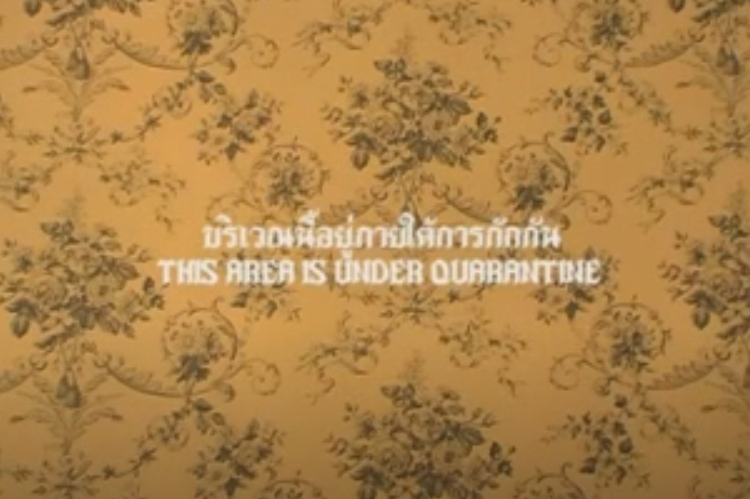
This Area Is Under Quarantine

A new documentary by Thai filmmaker Thunska Pansittivorakul, This Area Is Under Quarantine (บริเวณนี้อยู่ภายใต้การกักกัน), was screened at Makhampom Studio, Bangkok, last night. (All of his previous films were shown at a retrospective in April.) Before the premiere of this new feature-length documentary, there were screenings of his recent short films Action! (which premiered at the 5th Bangkok Experimental Film Festival, and is currently showing as part of the 4th Project 6) and Middle-Earth (มัชฌิมโลก, which premiered at the 11th Thai Short Film and Video Festival), and his music video Blinded Spot. Most of the photographs from Thunska’s recent Life Show exhibition were also displayed, though the more explicit ones were missing.
Thunska has always made highly provocative films, and This Area Is Under Quarantine is no exception. Its first half resembles his short films Life Show (เปลือยชีวิต) and Chemistry (ปฏิกิริยา), with two gay men being interviewed about their past relationships. They later have sex with each other, filmed in close-up with a constantly moving camera, recalling Thunska’s short film Sigh (เมืองร้าง).
One of the men mentions that he is Muslim, which unexpectedly veers the discussion towards the notorious incident at Tak Bai in 2004 when seventy-eight Muslim men suffocated while held captive by the Thai army. Video footage of the Tak Bai incident is included, and Thaksin Shinawatra, who was Thailand’s prime minister at the time, is directly criticised in the film (albeit four years after the event).
Thunska has always made highly provocative films, and This Area Is Under Quarantine is no exception. Its first half resembles his short films Life Show (เปลือยชีวิต) and Chemistry (ปฏิกิริยา), with two gay men being interviewed about their past relationships. They later have sex with each other, filmed in close-up with a constantly moving camera, recalling Thunska’s short film Sigh (เมืองร้าง).
One of the men mentions that he is Muslim, which unexpectedly veers the discussion towards the notorious incident at Tak Bai in 2004 when seventy-eight Muslim men suffocated while held captive by the Thai army. Video footage of the Tak Bai incident is included, and Thaksin Shinawatra, who was Thailand’s prime minister at the time, is directly criticised in the film (albeit four years after the event).
The Tak Bai scenes are taken from a VCD issued by the journal Same Sky (ฟ้าเดียวกัน) in defiance of a ban imposed by the Thaksin government. Since then, the footage has become more widely available: earlier this year, a Tak Bai documentary — นี้คือ...ความจริงที่ตากใบ (‘this is... the truth about Tak Bai’) — was released on VCD alongside an older documentary about the ‘Black May’ protests. (Strangely, the VCD cover features an unrelated photograph from 14th October 1973.)
There were a few technical glitches at last night’s sold-out screening. The film will be shown again at the same venue on 1st September.
19 August 2008
Life With My Sister Madonna
The book's main focus is on his professional relationship with his sister. Over the years, she has employed him as an interior designer and stage director, and he writes at length about his demeaning chores and paltry compensation. It's hard to feel much sympathy though, because he also complains when she doesn't hire him.
He is evidently jealous of the men in her life, and he makes it clear that he can't stand her husband, Guy Ritchie. His personal offence at the wedding speech of Ritchie's best man seems like a massive over-reaction. Also, for some strange reason, he is surprised that Ritchie wants to approve the decor of their home rather than giving Ciccone carte blanche to design it however he likes.
There's nothing really revelatory about Madonna in this book. Yes, she seems selfish and controlling, but we knew that already. Where are the details about Sean Penn tying her to a chair all night?
16 August 2008
The Empire Top 500
15 August 2008
Flashback '76
The 1976 massacre was previously the subject of Manit's Horror In Pink series, shown at From Message To Media. (That series was made in response to Samak being elected governor of Bangkok in 2000 by an electorate that had seemingly forgotten his role as an agitator in the buildup to the massacre.) Ing K.'s ไทยมุง series, watercolour portraits of the crowd from Neal Ulevich's famous photograph of the massacre, are also include. Flashback '76, at the Pridi Banomyong Institute in Bangkok, opened on 2nd August, and will close on Saturday.
13 August 2008
Halliwell's Film Guide 2008
Leslie Halliwell was famous for his dislike of modern cinema, refusing to give his maximum four stars to any film made after Bonnie & Clyde. His capsule reviews would damn many films with faint praise, and it's quite fun to look up your favourite films to read the criticisms which accompany even the highest-rated titles. The Seventh Seal, for instance, is a "minor classic", and Annie Hall was successful for "no good reason". Too often, a film's narrative structure is unfairly criticised; for example, Citizen Kane has "gaps in the narrative", Jaws is "slackly narrated", Dr Strangelove has an "untidy narrative", and so on.
In his stint as editor, John Walker rewrote some of the most acerbic reviews and revised many of the star ratings. At the last minute, he requested that his name be removed from this latest edition, hence the sticker bearing David Gritten's name covering Walker's.
Gritten has improved the Guide's layout, with blue text for each film title and a line between each entry. The star ratings are now much more generous than in Halliwell's day - perhaps too generous. The latest edition reviews more than 24,000 films, which is more than most other guides though less than the 27,000 in the current edition of VideoHound's Golden Movie Retriever. VideoHound only includes films available on VHS or DVD, however, so while it does feature DTV titles missing from Halliwell's, it doesn't cover any titles which were released theatrically but not on video. For that reason, Halliwell's is still necessary.
05 August 2008
Unspeak
'Surgical strike', for example, is used in war reporting to describe a military attack in which only the specific target is destroyed, with no damage to civilians or surrounding infrastructure. 'Surgical' suggests a fine degree of precision, just as a medical surgeon performs delicate surgical procedures. Furthermore, during medical surgery the patient is anaesthetised, thus 'surgical strike' implies painlessness. Finally, military action is linguistically equated with the removal of disease, thus giving it positive associations. By describing military operations as 'surgical strikes', politicians are therefore communicating a subtle ideological message, which is unthinkingly repeated by journalists who adopt the same terminology in their war reporting.
Poole shows how so much political and military discourse utilises metaphors which have been chosen by spin doctors for their ideological implications, and, more worryingly, how these terms have pervasively entered conventional public discourse. Kenneth Burke describes this process, when our selection of terminology limits our perceptions, as 'terministic screening', and Quentin Skinner refers to 'evaluative-descriptive terms', words which are employed objectively despite their subjective origins.
02 August 2008
Diary Of The Dead
Like Cannibal Holocaust and The Blair Witch Project, Diary Of The Dead is a 'mockumentary' comprised of purportedly recovered footage. As in those two earlier films, we are first introduced to the filmmakers and their equipment (taking care to establish the multiple cameras, thus enabling the real filmmaker to justify shot/reverse-shot editing). The same themes - that filming an event makes it more real, and that the camera viewfinder filters reality - are explored in all three films.
Diary Of The Dead's film-within-the-film is titled The Death Of Death. The film's real title, and Romero's name, do not appear until the end credits, though Romero does have a cameo role as a police officer (and there are also cameos by Quentino Tarantino and Wes Craven, as radio reporters).
Funny Games
This year, Haneke remade Funny Games in Hollywood. The only differences are the language (English) and the cast (led by Naomi Watts and Tim Roth). The script has not been changed, and the same ideas are explored: the total emasculation of the husband/father, the sudden disruption of bourgeois complacency, and the breaking of the fourth wall to render the audience complicit in the action.
The soundtrack, camerawork, and editing are practically identical to the original Funny Games, to an even greater degree than Gus van Sant's Psycho remake. To such an extent, in fact, that the exercise becomes redundant - why don't American viewers simply watch the subtitled original version?
Watts and Roth can't quite hide their natural movie-star charismas, in contrast to the utterly unselfconscious performances of the original actors (Susanne Lothar and Ulrich Muhe). Brady Corbet, as Peter, successfully adopts the mannerisms of Frank Giering, who originally played the character. Michael Pitt, playing Paul, is less chilling than Arno Frisch's original interpretation of the same role.