

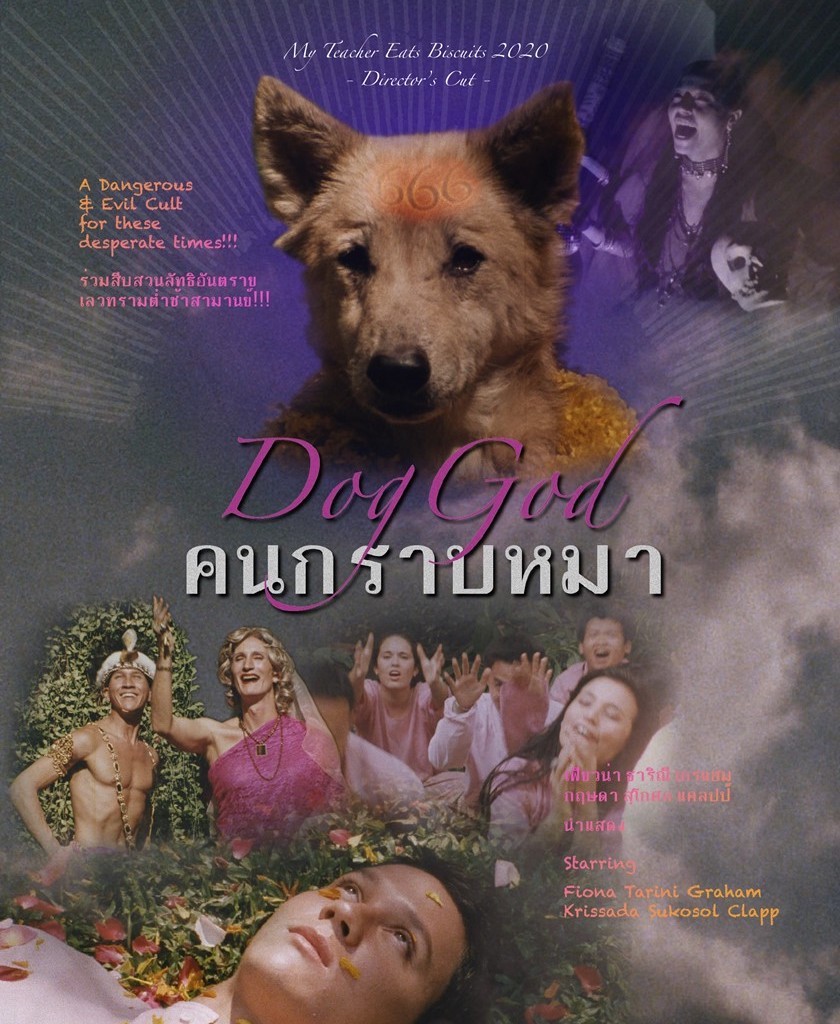
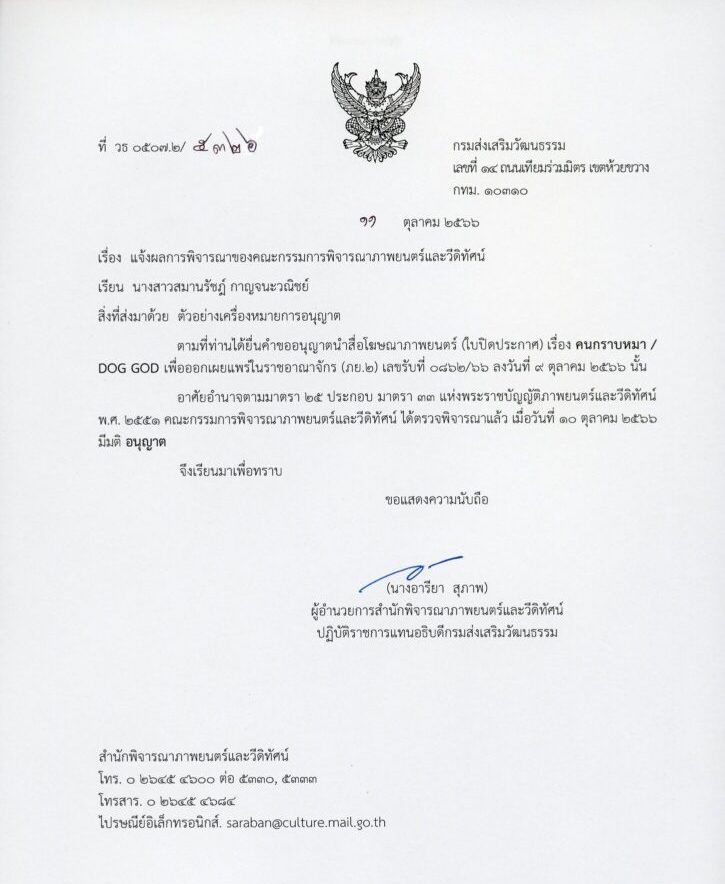
Ing K.’s film My Teacher Eats Biscuits will finally be shown in Thailand, more than twenty-five years after it was banned. Ing re-edited the film in 2020, and this director’s cut — ten minutes shorter than the original version — was approved by the film censorship board last October. It will go on general release on 16th May. Although its Thai title (คนกราบหมา) remains the same, its English title has been changed to the more prosaic Dog God.
My Teacher Eats Biscuits was banned on the eve of the inaugural Bangkok Film Festival in 1998, along with the Singaporean drama Bugis Street (妖街皇后). On the opening night of the Alternative Love Film Festival later that year, Ing showed a video of her meeting with a parliamentary committee discussing My Teacher Eats Biscuits, and screened Bugis Street in defiance of the ban. Police raided the Saeng-Arun Arts Centre during the screening of Bugis Street, though they left the auditorium shortly afterwards.
The film was banned on the grounds that it satirised religion. As the director explained in an interview for Thai Cinema Uncensored: “This is like banning John Waters’ Pink Flamingos for bad taste!” In other words, the religious satire was the whole point of the film. (In that interview, Ing alleged that one member of the censorship board, a Chulalongkorn University professor, dominated the board and led the decision to ban the film. Another reason for the ban was that the censors misinterpreted a character, Princess Serena, as an impersonation of Princess Galyani.)
Like Pink Flamingos, My Teacher Eats Biscuits is a low-budget, independent movie shot on 16mm. (Coincidentally, Pink Flamingos was also passed by the Thai censors last year.) A plot synopsis — a monk catches another monk in the act of necrophilia, and a woman establishes a cult of dog worshippers — gives the false impression that My Teacher Eats Biscuits is offensive or blasphemous. In fact, the film has a camp sensibility (which it shares with Pink Flamingos), and its tone is clearly parodic.
My Teacher Eats Biscuits was banned on the eve of the inaugural Bangkok Film Festival in 1998, along with the Singaporean drama Bugis Street (妖街皇后). On the opening night of the Alternative Love Film Festival later that year, Ing showed a video of her meeting with a parliamentary committee discussing My Teacher Eats Biscuits, and screened Bugis Street in defiance of the ban. Police raided the Saeng-Arun Arts Centre during the screening of Bugis Street, though they left the auditorium shortly afterwards.
The film was banned on the grounds that it satirised religion. As the director explained in an interview for Thai Cinema Uncensored: “This is like banning John Waters’ Pink Flamingos for bad taste!” In other words, the religious satire was the whole point of the film. (In that interview, Ing alleged that one member of the censorship board, a Chulalongkorn University professor, dominated the board and led the decision to ban the film. Another reason for the ban was that the censors misinterpreted a character, Princess Serena, as an impersonation of Princess Galyani.)
Like Pink Flamingos, My Teacher Eats Biscuits is a low-budget, independent movie shot on 16mm. (Coincidentally, Pink Flamingos was also passed by the Thai censors last year.) A plot synopsis — a monk catches another monk in the act of necrophilia, and a woman establishes a cult of dog worshippers — gives the false impression that My Teacher Eats Biscuits is offensive or blasphemous. In fact, the film has a camp sensibility (which it shares with Pink Flamingos), and its tone is clearly parodic.
The film begins with a voice-over by Ing, describing her character’s previous incarnation as a devout monk. He reports the necrophile monk to his abbot, who seems completely unconcerned. Disillusioned by Buddhism, he burns his saffron robe, and is reincarnated as a woman, Satri, played by the director. At the end of the film, Satri explains her rejection of organised religion in an extended monologue: “I had to free myself from the pollution of the yellow robe, which, in my eyes, became a symbol of corruption.”
Satri’s cult is exposed as a fraud by two undercover investigators, though the film presents Buddhism as equally hypocritical. When an investigator tells a senior monk (who drinks whiskey) about the cult, his response is: “A dog in a monk’s robe is not so bad.” Reflecting on this, the investigator concludes: “With monks like him, no wonder the image of Buddhism gets worse and worse.” We are later informed that he has left to investigate “a drunken orgy with seven senior monks.”
After the ban, My Teacher Eats Biscuits was rarely seen, either in Thailand or elsewhere. As critic Graiwoot Chulpongsathorn wrote in 2009, it is “a film so controversial that it has been ‘disappeared’ from history.” It was shown at the Goethe-Institut in Bangkok in 1998, and at Chulalongkorn University’s Faculty of Political Science on 17th December 2009. At the Chulalongkorn screening, Ing explained that the necrophile monk character was based on a news story about a real monk, and that when she told this to the censors, their candid answer was: “ข่าวสารเรา control ไม่ได้ แต่หนังเรา control ได้” (‘we can’t control news, but we can control movies’).
The film had three European screenings in 2017. It was shown at the Close-Up Film Centre in London; at the Deutsches Filminstitut in Frankfurt, Germany; and at the Cinéma du réel (‘cinema of the real’) festival in Paris. To celebrate the film’s return to Thai cinemas, Ing has designed t-shirts with the slogan “กราบหมาเถิดลูก” (‘bow down to the dog’). There is also a Shakespeare Must Die (เชคสเปียร์ต้องตาย) t-shirt, with the slogan “From the Cursed Play, a Forbidden Horror Movie” (“หนังผีต้องห้าม จากละครต้องสาป”).
When Shakespeare Must Die was banned in 2012, Ing had the dubious distinction of being the only Thai director with two films banned simultaneously. Now both films have been passed by the censors — the Shakespeare Must Die ban was lifted in February — and they will both return to Thai cinemas this year. My Teacher Eats Biscuits and Shakespeare Must Die appear to be early beneficiaries of a liberalised censorship policy announced by the National Soft Power Strategy Committee in January.
Satri’s cult is exposed as a fraud by two undercover investigators, though the film presents Buddhism as equally hypocritical. When an investigator tells a senior monk (who drinks whiskey) about the cult, his response is: “A dog in a monk’s robe is not so bad.” Reflecting on this, the investigator concludes: “With monks like him, no wonder the image of Buddhism gets worse and worse.” We are later informed that he has left to investigate “a drunken orgy with seven senior monks.”
After the ban, My Teacher Eats Biscuits was rarely seen, either in Thailand or elsewhere. As critic Graiwoot Chulpongsathorn wrote in 2009, it is “a film so controversial that it has been ‘disappeared’ from history.” It was shown at the Goethe-Institut in Bangkok in 1998, and at Chulalongkorn University’s Faculty of Political Science on 17th December 2009. At the Chulalongkorn screening, Ing explained that the necrophile monk character was based on a news story about a real monk, and that when she told this to the censors, their candid answer was: “ข่าวสารเรา control ไม่ได้ แต่หนังเรา control ได้” (‘we can’t control news, but we can control movies’).
The film had three European screenings in 2017. It was shown at the Close-Up Film Centre in London; at the Deutsches Filminstitut in Frankfurt, Germany; and at the Cinéma du réel (‘cinema of the real’) festival in Paris. To celebrate the film’s return to Thai cinemas, Ing has designed t-shirts with the slogan “กราบหมาเถิดลูก” (‘bow down to the dog’). There is also a Shakespeare Must Die (เชคสเปียร์ต้องตาย) t-shirt, with the slogan “From the Cursed Play, a Forbidden Horror Movie” (“หนังผีต้องห้าม จากละครต้องสาป”).
When Shakespeare Must Die was banned in 2012, Ing had the dubious distinction of being the only Thai director with two films banned simultaneously. Now both films have been passed by the censors — the Shakespeare Must Die ban was lifted in February — and they will both return to Thai cinemas this year. My Teacher Eats Biscuits and Shakespeare Must Die appear to be early beneficiaries of a liberalised censorship policy announced by the National Soft Power Strategy Committee in January.