





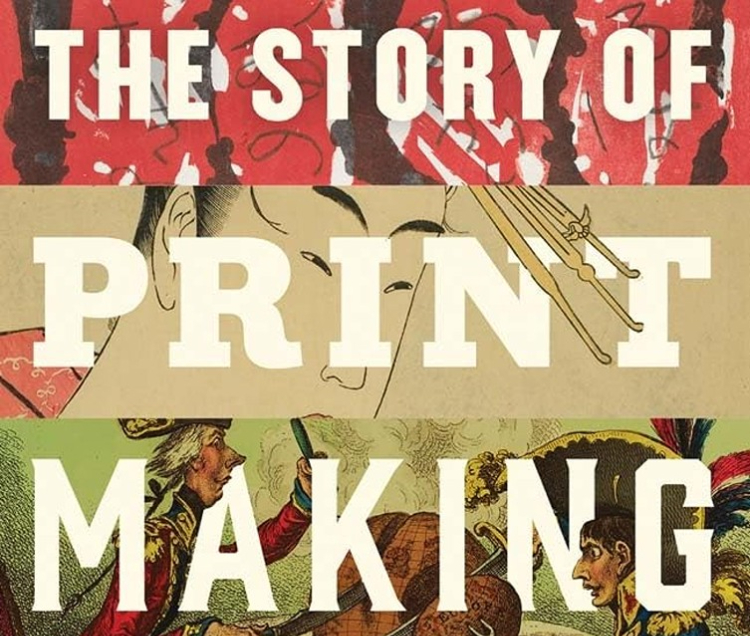
It has been thirty years since the last general history of artists’ prints — The Print in the Western World, by Linda C. Hults — was published. The Story of Printmaking, a new book on the subject by Holly E.J. Black, explains the major printmaking techniques and celebrates the artists who mastered them.
Black writes about the development of etching, mezzotint, aquatint, woodblock printing, lithography, and screenprints. She credits Jules Chéret as “the forefather of lithography,” Andy Warhol as the “one name that is truly synonymous with screenprinting”, and Francisco de Goya as the “artist who harnessed the possibilities of the [aquatint] medium like no other”. She argues that Sumida Hokusai’s The Great Wave (神奈川沖浪裏) is one of “a handful of artworks in existence that have become so utterly imprinted on the public consciousness that they deserved to be called ‘iconic’.”
The Story of Printmaking also highlights “the lesser-known players who have been deliberately or erroneously overlooked.” Many of these are female artists and printmakers, some of whom are relatives of more famous male figures. The book covers an extensive timeline and geographical range, though it’s quite episodic — with entire chapters on Mexico and South Africa, for example — rather than being a comprehensive history.
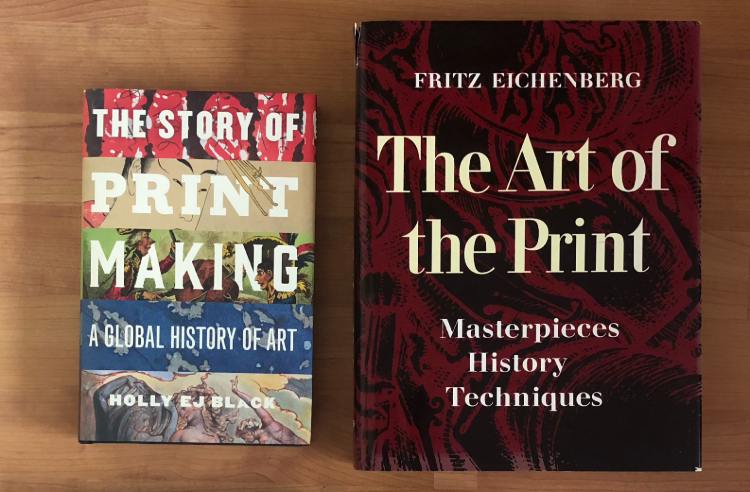
The Print in the Western World was almost 1,000 pages long, and an earlier history, The Art of the Print by Fritz Eichenberg, was similarly monumental at 600 pages. In contrast, at around 250 pages The Story of Printmaking feels less substantial than its subtitle (A Global History of Art) implies.
Black writes about the development of etching, mezzotint, aquatint, woodblock printing, lithography, and screenprints. She credits Jules Chéret as “the forefather of lithography,” Andy Warhol as the “one name that is truly synonymous with screenprinting”, and Francisco de Goya as the “artist who harnessed the possibilities of the [aquatint] medium like no other”. She argues that Sumida Hokusai’s The Great Wave (神奈川沖浪裏) is one of “a handful of artworks in existence that have become so utterly imprinted on the public consciousness that they deserved to be called ‘iconic’.”
The Story of Printmaking also highlights “the lesser-known players who have been deliberately or erroneously overlooked.” Many of these are female artists and printmakers, some of whom are relatives of more famous male figures. The book covers an extensive timeline and geographical range, though it’s quite episodic — with entire chapters on Mexico and South Africa, for example — rather than being a comprehensive history.
The Print in the Western World was almost 1,000 pages long, and an earlier history, The Art of the Print by Fritz Eichenberg, was similarly monumental at 600 pages. In contrast, at around 250 pages The Story of Printmaking feels less substantial than its subtitle (A Global History of Art) implies.
The first complete history of printmaking, Six Centuries of Fine Prints by Carl Zigrosser, was published in 1937. This was followed in the 1950s by Prints and Visual Communication (by William M. Ivens) and 500 Years of Printing (by S.H. Steinberg).
There are also authoritative books on specific printmaking techniques:
Woodcuts
There are also authoritative books on specific printmaking techniques:
Woodcuts
- A History of Wood Engraving (Douglas Percy Bliss)
- A History of Wood Engraving (Albert Garrett)
- Scene Through Wood (Anne Desmet)
- Screenprints (Gill Saunders)
- The Mezzotint (Carol Wax)
- Aquatint (Rena M. Hoisington)
- A History of Engraving and Etching (Arthur M. Hind)
- Linocuts (Ella Ravilious)
- A History of Lithography (Wilhelm Weber)
- Lithography (Domenico Porzio)
- The Painterly Print (Margaret Aspinwall)
- The Monotype (Carla Esposito Hayter)
- Images from the Floating World (Richard Lane)