




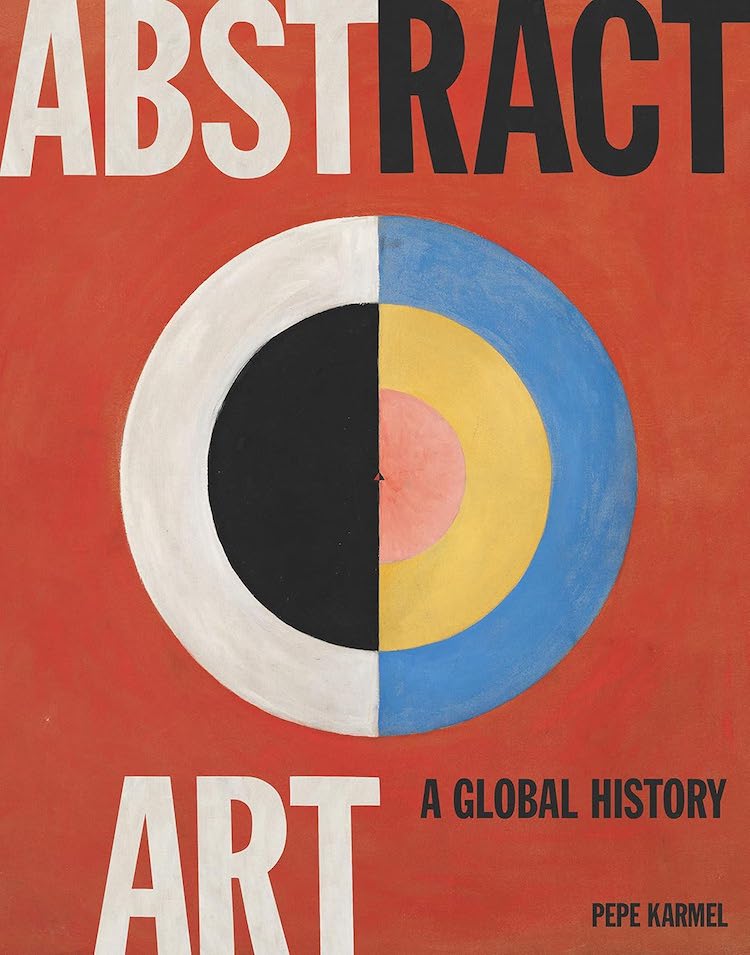
Pepe Karmel’s Abstract Art: A Global History was first published in 2020, followed by an expanded edition last year. Karmel begins with a close analysis of major paintings by “the three best-known creators of abstract art” — Vasily Kandinsky, Piet Mondrian, and Kazimir Malevich — and identifies apparent figurative origins within their abstract compositions. He then applies this revisionist methodology to later abstract artists: “If these key examples from the history of abstraction reveal concealed subject matter, perhaps the same is true of all abstract art.”
This informs his central thesis, that abstract art is the culmination of a creative process involving the transformation of figurative imagery: “The argument of this book, in brief, is that abstract artists always begin with a visual theme or archetype combining abstract forms with meanings generated by associations with the real world.” Note his use of words such as “all” and “always”: these are bold claims.
Karmel also rejects a chronological approach to art history, explaining that it’s not possible to cover each of the various movements and ‘isms’ that influenced the development of abstract art: “There is no narrative thread that could hold all of these together.” Nevertheless, previous histories of the subject, beginning with Michel Seuphor’s Dictionary of Abstract Painting and Abstract Painting, had a more traditional chronological structure.
Instead, Karmel’s book is organised thematically, into five broad categories: bodies, landscapes, cosmologies, architectures, and signs and patterns. Again, this imposes figurative origins onto abstract images, and despite the book’s subtitle, the result is a selective survey rather than a comprehensive history. (“I have chosen the artists who most clearly illustrate the arguments I want to make. Other, equally wonderful artists have been omitted.”) But it’s still the first major study of abstract art in more than thirty years, and it has an extensive bibliography.
When discussing the origins of abstract art, Karmel cites František Kupka’s 1912 painting Amorpha as a precursor to the Kandinsky/Mondrian/Malevich triumvirate. He is also among several writers in recent years who credit Hilma af Klint as a previously unsung pioneer of geometric abstraction. But there are two even earlier abstract artists who go unmentioned: Arnaldo Ginna and Victor Hugo.
Ginna’s 1908 painting Nevrastenia (‘neurasthenia’) has been described as “probably the first abstract painting in the history of Western art” (in Giannalberto Bendazzi’s Cartoons). Hugo’s fascinating stain-paintings were created from random splashes of ink, one of which was even titled Abstract Composition. (The work is undated, though it was produced in the 1860s.)
The Spiritual in Art, the 1986 exhibition that first rediscovered af Klint, was also arranged according to five themes, though only one of which (cosmic imagery, like the cosmologies chapter in Karmel’s book) was related to figurative images. Its extensive exhibition catalogue, edited by curator Maurice Tuchman, featured chapters covering artists and movements rather than visual classifications.
This informs his central thesis, that abstract art is the culmination of a creative process involving the transformation of figurative imagery: “The argument of this book, in brief, is that abstract artists always begin with a visual theme or archetype combining abstract forms with meanings generated by associations with the real world.” Note his use of words such as “all” and “always”: these are bold claims.
Karmel also rejects a chronological approach to art history, explaining that it’s not possible to cover each of the various movements and ‘isms’ that influenced the development of abstract art: “There is no narrative thread that could hold all of these together.” Nevertheless, previous histories of the subject, beginning with Michel Seuphor’s Dictionary of Abstract Painting and Abstract Painting, had a more traditional chronological structure.
Instead, Karmel’s book is organised thematically, into five broad categories: bodies, landscapes, cosmologies, architectures, and signs and patterns. Again, this imposes figurative origins onto abstract images, and despite the book’s subtitle, the result is a selective survey rather than a comprehensive history. (“I have chosen the artists who most clearly illustrate the arguments I want to make. Other, equally wonderful artists have been omitted.”) But it’s still the first major study of abstract art in more than thirty years, and it has an extensive bibliography.
When discussing the origins of abstract art, Karmel cites František Kupka’s 1912 painting Amorpha as a precursor to the Kandinsky/Mondrian/Malevich triumvirate. He is also among several writers in recent years who credit Hilma af Klint as a previously unsung pioneer of geometric abstraction. But there are two even earlier abstract artists who go unmentioned: Arnaldo Ginna and Victor Hugo.
Ginna’s 1908 painting Nevrastenia (‘neurasthenia’) has been described as “probably the first abstract painting in the history of Western art” (in Giannalberto Bendazzi’s Cartoons). Hugo’s fascinating stain-paintings were created from random splashes of ink, one of which was even titled Abstract Composition. (The work is undated, though it was produced in the 1860s.)
The Spiritual in Art, the 1986 exhibition that first rediscovered af Klint, was also arranged according to five themes, though only one of which (cosmic imagery, like the cosmologies chapter in Karmel’s book) was related to figurative images. Its extensive exhibition catalogue, edited by curator Maurice Tuchman, featured chapters covering artists and movements rather than visual classifications.